
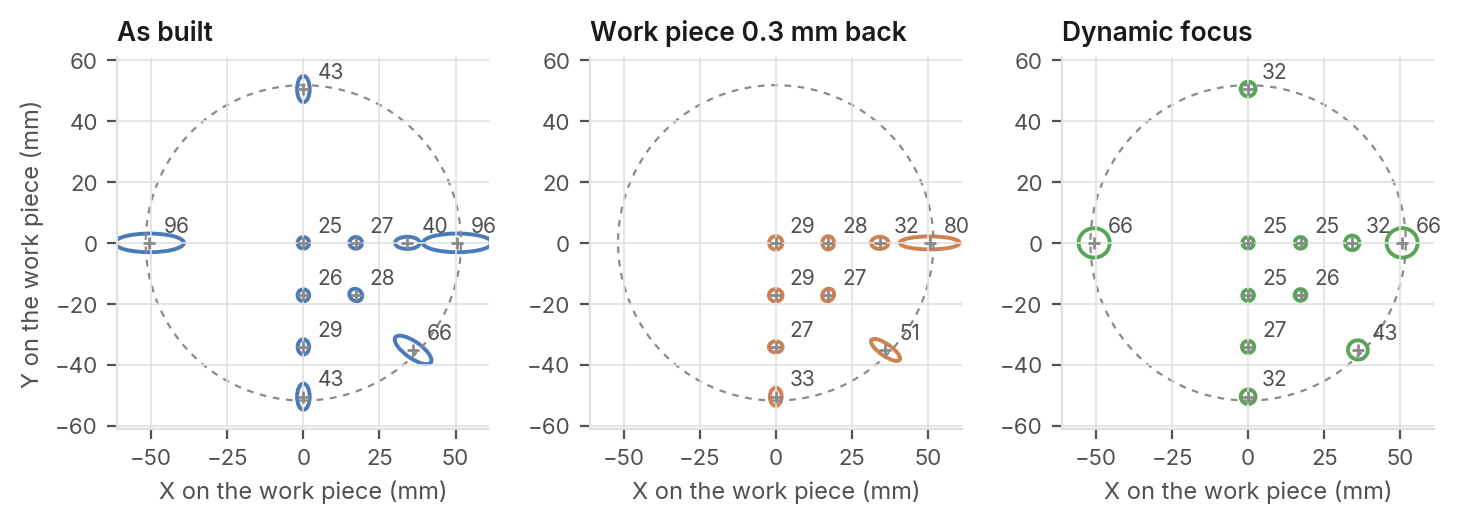
 Spot size and shape across the field of a galvo scanner with a telecentric F-theta lens
80 W femtosecond laser at 1030 nm, two-axis galvo head, ±18° scan field
Laser propagation
A laser beam is not a cloud of rays: it is a coherent field, with a well-defined waist, divergence and wavefront.
It is also a source of energy that heats, deforms and sometimes destroys what it passes through. The physical propagation engine follows this field from waist to wavefront, and hands over to the other engines without rebuilding the system.
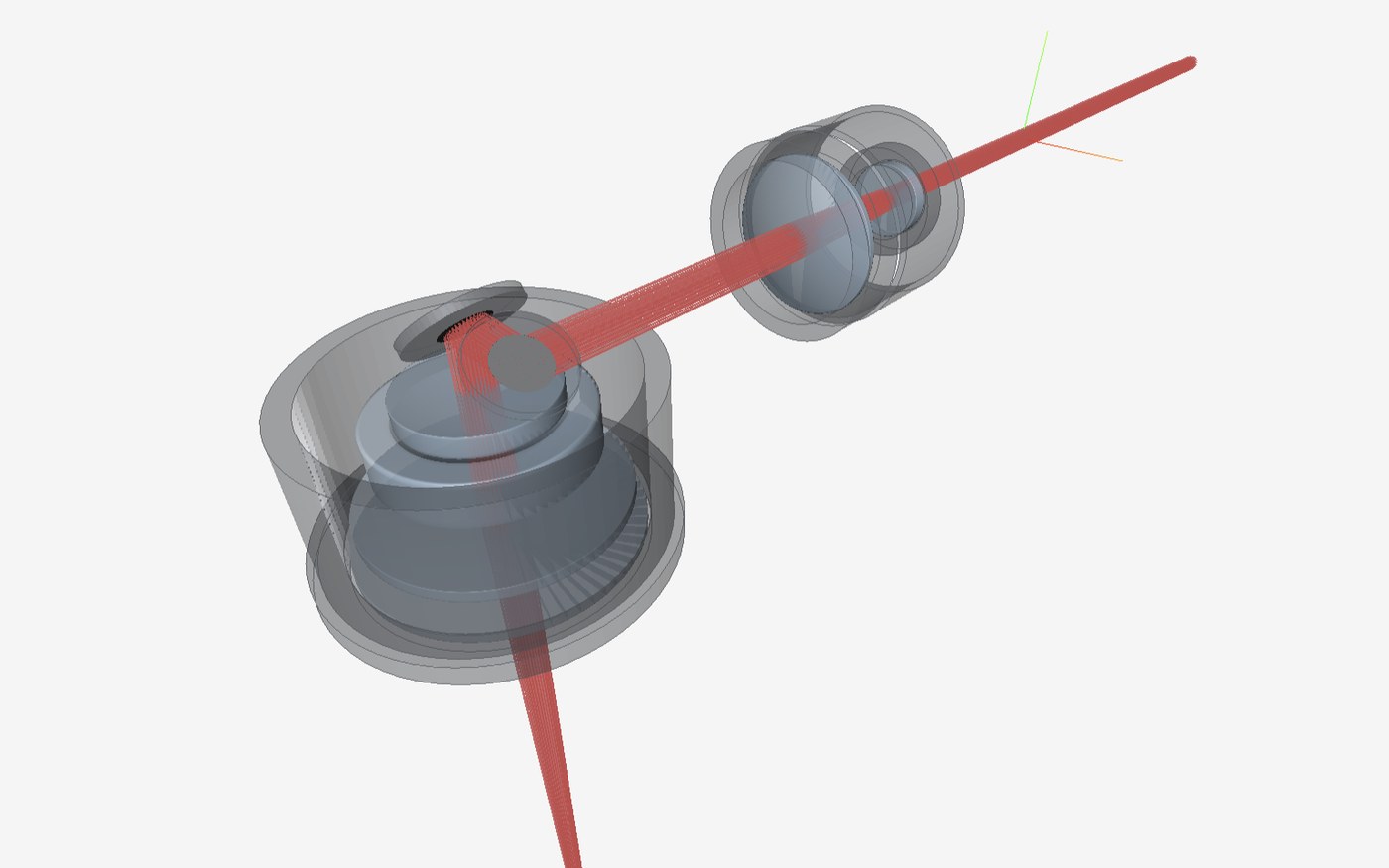
Beam shaping
Beam-shaping tools, based on freeform optics or spatial light modulators (SLM), produce exactly the profile you want. The shaped beam is then propagated through the rest of the system.
Ultrashort pulses
For femtosecond pulses, the wave engine tracks dispersion, pulse-front tilt and the Kerr lens induced in each glass, recomputed until the beam no longer changes. The B-integral shows when spectral broadening, which is not modelled, becomes significant.
High power
Non-sequential mode shows where the energy really goes: ghost reflections, stray light, power deposited on each face. For continuous-wave lasers, the thermo-mechanical engine closes the loop: heated optics are rebuilt and the beam traced again, until it no longer changes.
From the lab to production
You follow the real beam and its effects without ever rebuilding the system between two analyses. On a grating system, the chosen diffraction orders are traced through the same optics.
Use cases
Spot size and shape across the field of a galvo scanner with a telecentric F-theta lens
80 W femtosecond laser at 1030 nm, two-axis galvo head, ±18° scan field
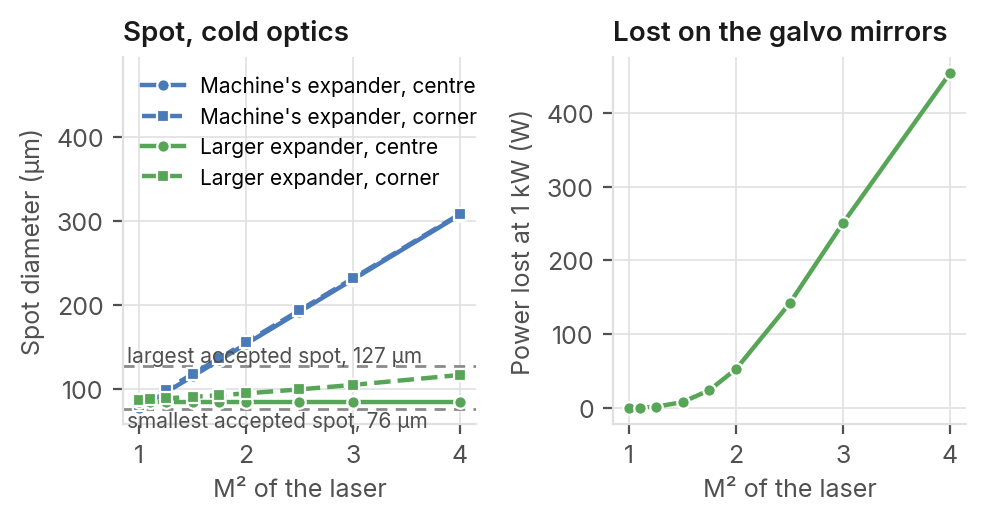 Integrating lower-quality fibre lasers in an LPBF machine: spot size at the powder bed
1 kW fibre laser at 1070 nm, two-axis galvo head and F-theta lens, 250 × 250 mm build plate
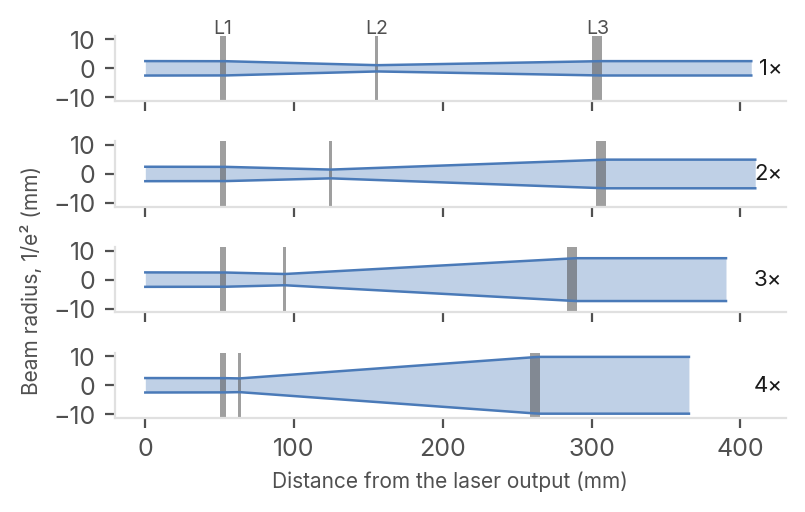 Collimation and thermal lens of a 1×–4× zoom beam expander at 1 kW
Galilean zoom with three fused-silica lenses, four zoom positions optimized together, 1030 nm continuous laser from 100 W to 1 kW
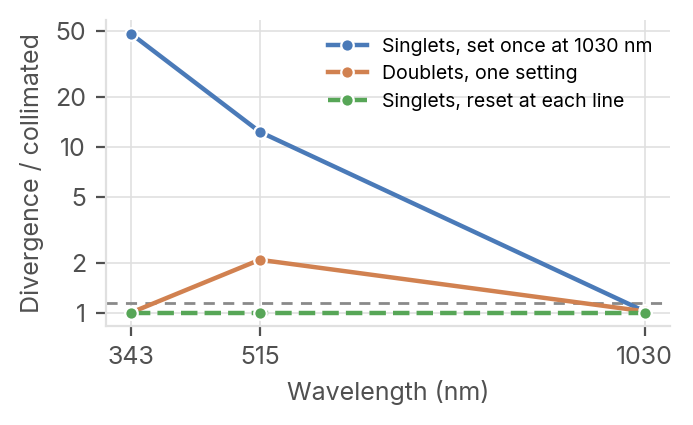 Lens spacing of a 3× beam expander used at 1030, 515 and 343 nm
Fused-silica singlets against CaF2 / fused-silica doublets for the three harmonics of a Yb laser, with the collimation read on the Gaussian beam at each line
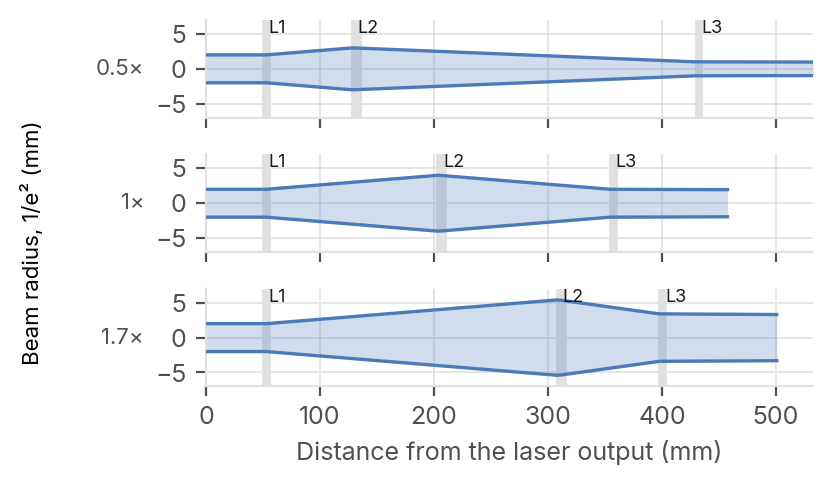 B-integral and pulse duration in a 0.5× to 1.7× ultrafast zoom beam expander
Three-lens Galilean zoom behind a 1030 nm femtosecond laser, 7 variants, pulse propagated through the real system at each position
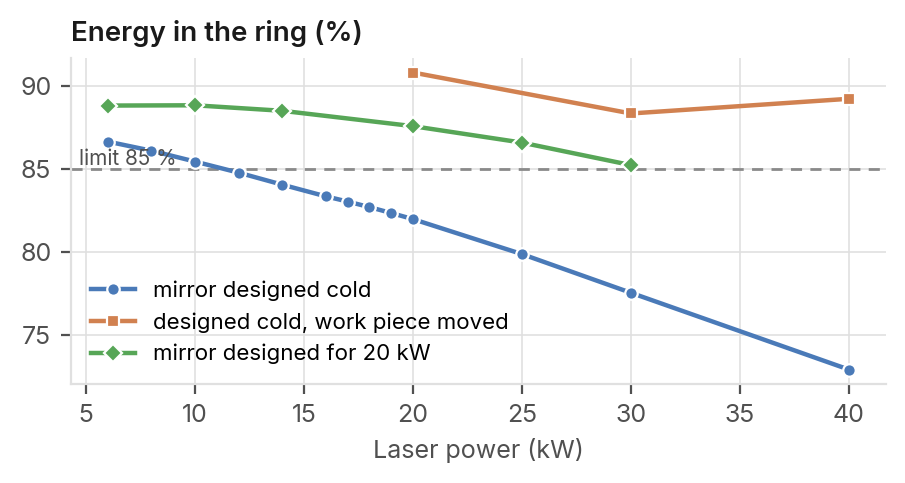 Thermal limits of a freeform ring-shaping head for a multimode fibre laser
Laser welding head at 1030 nm, ring of 3 / 2 mm diameter, laser power from 6 kW to 40 kW
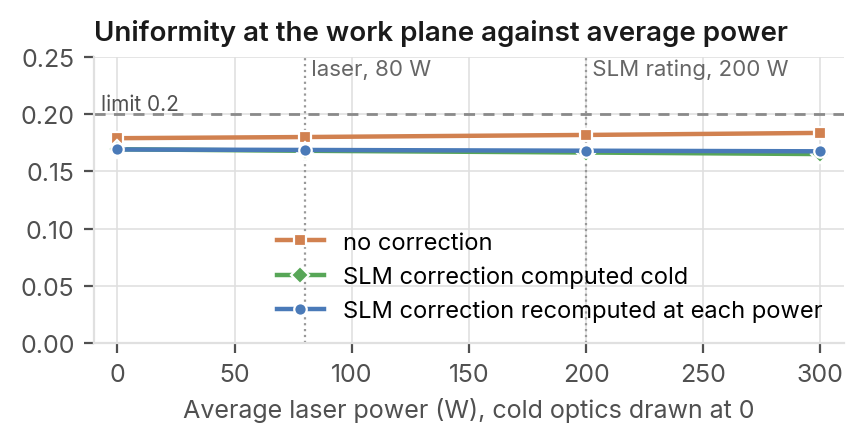 Square top-hat from a femtosecond laser with a phase-only LCOS SLM
80 W femtosecond laser at 1030 nm, 300 µm square top-hat, average power from 0 to 300 W
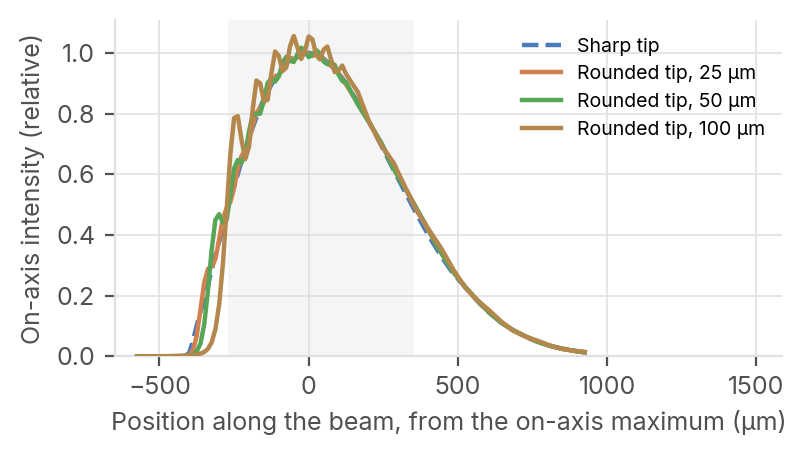 Core size, zone length and axicon tip tolerance of a Bessel beam shaper for glass cutting
Ultrashort-pulse laser at 1030 nm, fused-silica axicon and a reducing telescope, after Balage et al.; wave-optics field computed plane by plane along the Bessel zone