
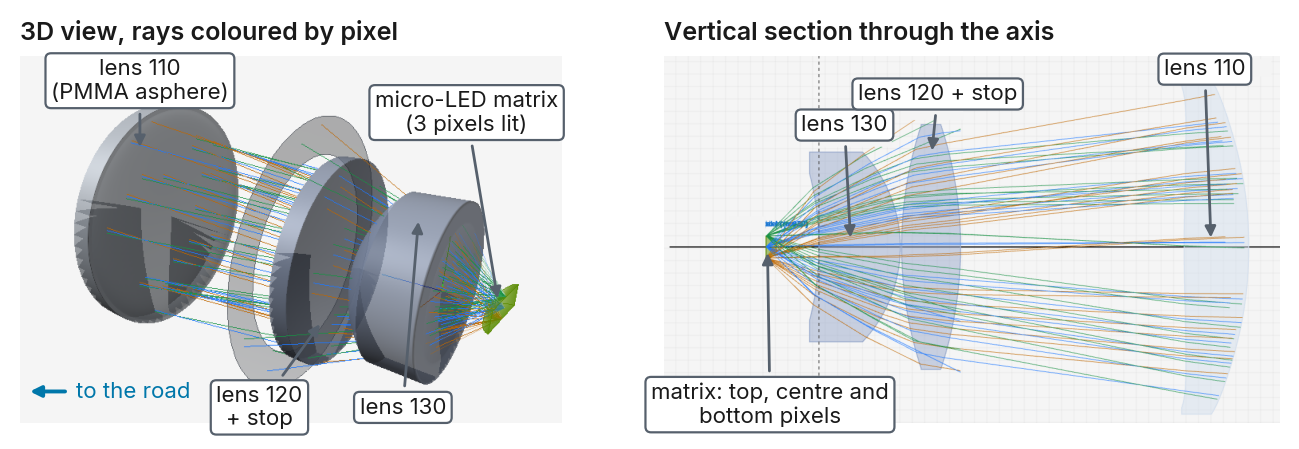
 Projecting a micro-LED matrix headlamp: beam intensity, pixel separation and the dark zone around an oncoming car
256 × 64 pixels on a 50 µm pitch, imaged by the three-lens projection lens of patent US 11428378 (f = 30.4 mm, f/0.67), judged against UN Regulation No. 149
Illumination
Illumination is a distribution problem: the right amount of light in the right place, with the uniformity, profile and efficiency you need.
Non-sequential mode traces hundreds of millions of rays per scene through reflectors, light guides and diffusers, from measured ray files or radiometric models.
Beam shaping
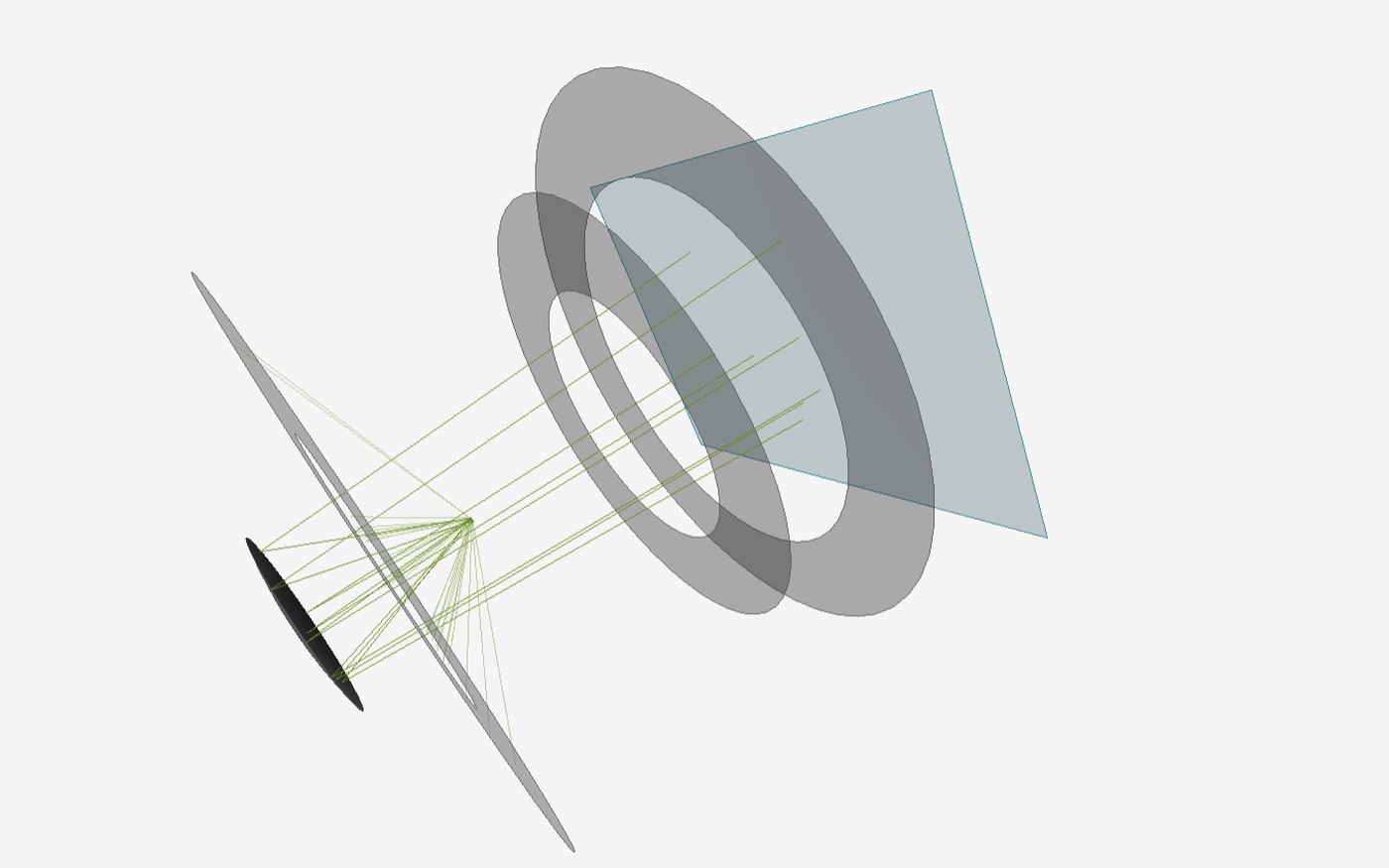
Beam shaping tools, freeform optics included, produce the distribution you want. But designing a luminaire also means designing the optics that create that distribution: the design starts in sequential mode for the surfaces, then converts into a non-sequential scene for the distribution, without being rebuilt.
The thermal environment
An illumination system also operates in a thermal environment: a heat source close to an optic, a vehicle headlamp, or a camera that must work as well at −20 °C as at +40 °C. The thermomechanical engine checks the light-shaping optics across the whole temperature range.
Iterating in the cloud
When an illumination system needs many iterations to converge, the simulations move to the cloud and run in parallel. From the first sketch to the toleranced luminaire, without changing models.
Use cases
Projecting a micro-LED matrix headlamp: beam intensity, pixel separation and the dark zone around an oncoming car
256 × 64 pixels on a 50 µm pitch, imaged by the three-lens projection lens of patent US 11428378 (f = 30.4 mm, f/0.67), judged against UN Regulation No. 149