 Six-mirror EUV projection objective: aperture on the ring field, image quality and light budget
Four-times reduction, image-side NA 0.25, 13.4 nm, six aspheric mirrors after patent US 6,188,513
Imaging
Designing an imaging system means pushing image quality beyond what the eye can resolve, within a realistic size and budget.
Every step works on the same model: layout and optimization in sequential mode, then aberration analysis and tolerancing. When diffraction becomes the limit, physical optics takes over for MTF and PSF, with no manual conversion.
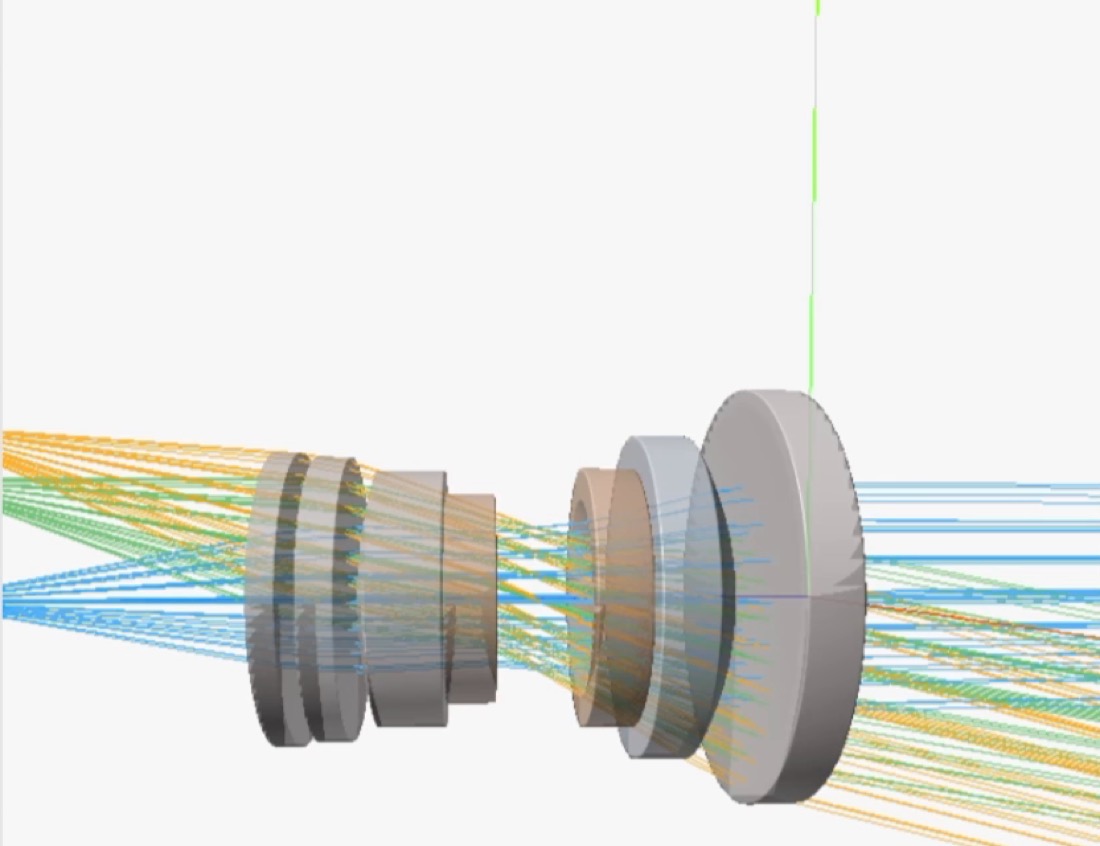
Under real conditions
An imaging system also has to perform under real conditions. A space telescope sees a thermal gradient between its sunlit and shaded sides. A phone camera or a high-end camera must work as well at −20 °C as at +40 °C. The thermomechanical engine accounts for these gradients and for the expansion of glasses and mounts, and checks image quality across the whole temperature range, with a full simulation at each temperature.
Tolerancing
Tolerancing decides whether a design can be built in volume, and this is where the cloud changes the scale: hundreds of perturbed systems, many fields and wavelengths, computed in parallel. You no longer tolerance a single case, but the complete design.
Use cases
Six-mirror EUV projection objective: aperture on the ring field, image quality and light budget
Four-times reduction, image-side NA 0.25, 13.4 nm, six aspheric mirrors after patent US 6,188,513
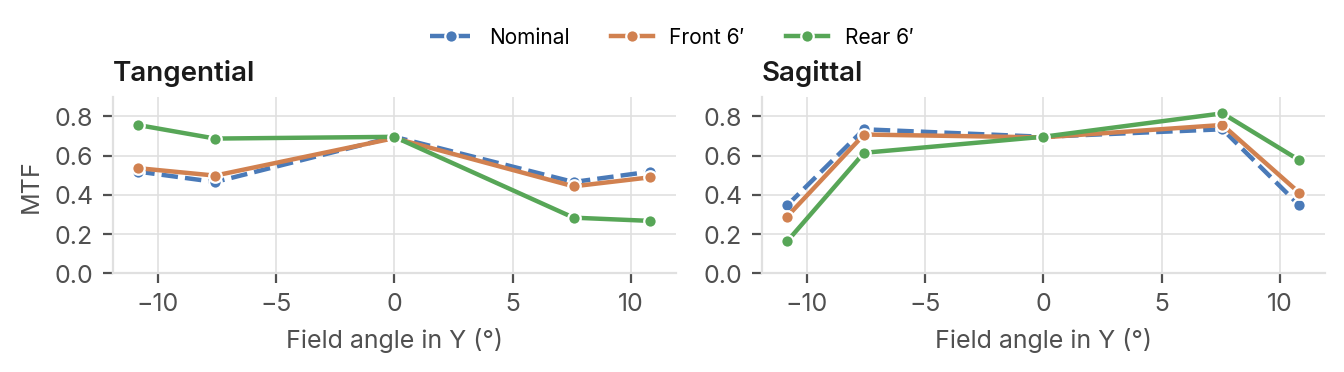 Image contrast of a 36 mm f/2 imaging lens with imposed group tilts
Eleven-lens objective of patent US 8,879,901, three lens groups, 12 variants, polychromatic MTF at 50 cycles/mm
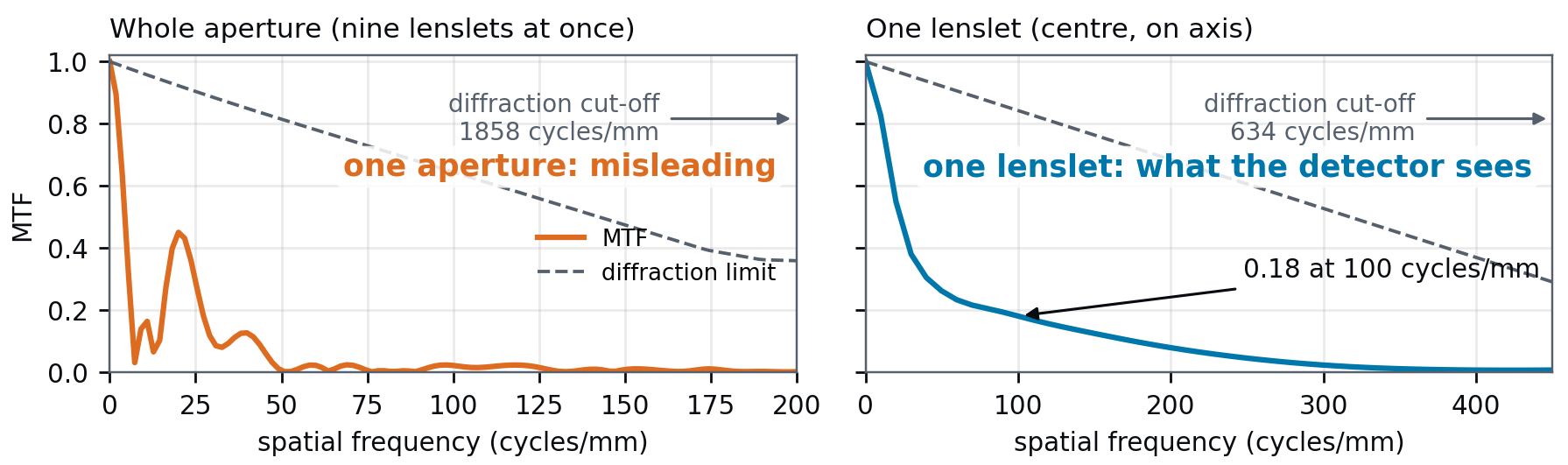 Designing a microlens array imager: per-lenslet image quality, crosstalk and manufacturing data
3 × 3 lens array, 1 mm pitch, re-imaged onto a detector by a 1:1 relay at 550 nm