
Ultrafast beam shaping
Square top-hat from a femtosecond laser with a phase-only LCOS SLM
80 W femtosecond laser at 1030 nm, 300 µm square top-hat, average power from 0 to 300 W
Square top-hat from a femtosecond laser with a phase-
only LCOS SLM
80 W femtosecond laser at 1030 nm, 300 μm square top-hat, average power from 0 to 300 W
| Application | Modelling approach |
| A phase-only spatial light modulator (SLM) can turn the | We modelled the set-up from the laser output to the work |
| round Gaussian beam of a femtosecond laser into a | plane, through a beam expander, the SLM and a Fourier |
| square spot of even irradiance, called a top-hat. The | lens. The beam was propagated as a wave through the |
phase pattern written on the SLM is computed for perfect real lenses, from cold optics up to 300 W. We judge the optics. This note asks what the SLM really delivers on the top-hat by its uniformity, the standard deviation of the machine, and what it costs. irradiance divided by its mean over the central 90 % of the square. We accept it below 0.2.
1 The set-up
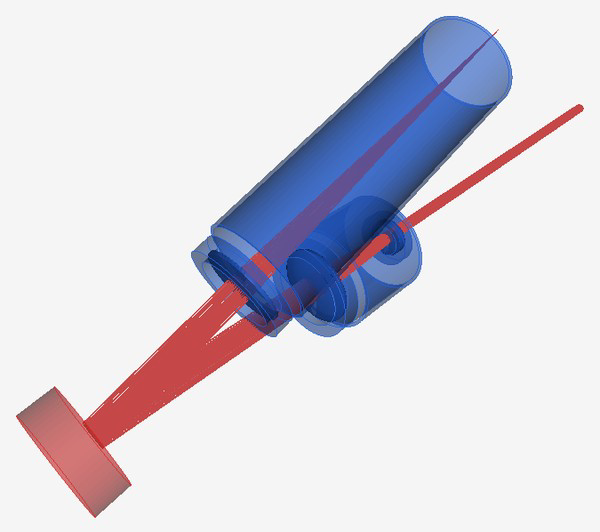
Figure 1. The set-up as modelled in etendue. A Galilean expander doubles the beam size. The SLM, tilted by 10° on a water-cooled support, writes the phase pattern. The Fourier lens focuses the beam on the work plane. Table 1. Main parameters.
| PARAMETER | VALUE | PARAMETER | VALUE |
| Average power | 80 W | Beam radius on the SLM (1/e²) | 5.1 mm |
| Pulse energy, duration | 400 μJ, 290 fs | SLM pixels | 1272 × 1024, 12.5 μm |
| Wavelength | 1030 nm | Fourier lens focal length | 250 mm |
| Beam quality M² | 1.2 | Top-hat | 300 × 300 μm |
2 The top-hat through the real optics uniformity 0.179, limit 0.2
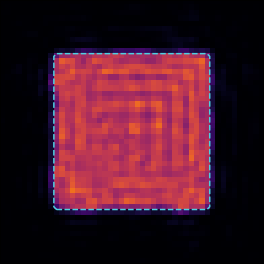
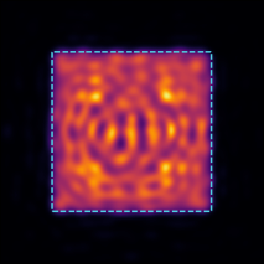
Does the top-hat survive the real lenses and the real beam? Yes, with a small margin. The design promised a uniformity of 0.108. Through the real optics it is 0.179, still under the limit of 0.2.
0.169
Uniformity when the SLM also corrects the wavefront
error of the lenses.
92 %
Share of the light that lands in the square.
| Figure 2a. Perfect optics. | Figure 2b. Real optics. |
| ^(U)pl^(n)a^(i)t^(f)e^(o)a^(r)u^(m).^(i)^(t)^(y)^(0)^(.)^(1)^(0)^(8)^(.)^(L)^(o)^(o)^(k)^(a)^(t)^(t)^(h)^(e) | ^(U)rip^(n)p^(i)^(f)l^(o)e^(r)s^(m).^(i)^(t)^(y)^(0)^(.)^(1)^(7)^(9)^(.)^(L)^(o)^(o)^(k)^(a)^(t)^(t)^(h)^(e) 0.19 to 0.28 |
Uniformity 0.5 mm either side of the work plane. The
top-hat is only flat close to focus.
3 Average power
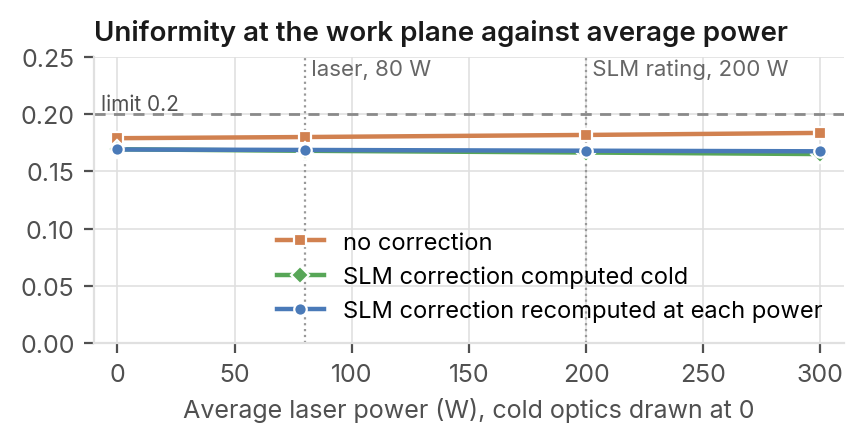
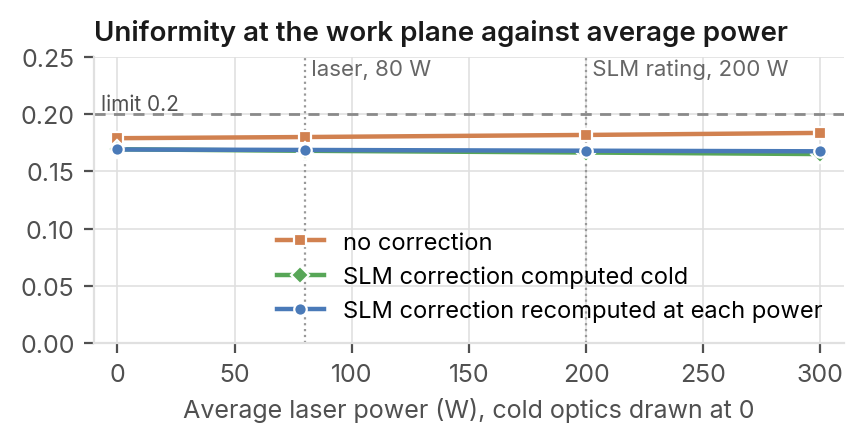
Does heat limit the average power? No. The lenses absorb very little, and the top-hat hardly changes up to the top of the range. The limit is the SLM itself, whose data sheet sets the highest power.
5 mW 0.165 to 0.184 52 μm 200 W
| Heat absorbed by the three | Uniformity from cold optics up Focus shift at 300 W. | Highest power in the SLM |
| lenses at 80 W. | to 300 W. | data sheet. |
etendue.io 80 W, 200 kHz, 400 μJ, 290 fs, 1030 nm · 300 μm square top-hat · etendue, October 2026
Where the top-hat loses its flatness, and what the SLM costs
The SLM receives more beam than the design assumed. That light is not shaped, and no phase pattern
can correct it.
Table 2. Uniformity near the work plane
Why the top-hat differs from the design
Distance from the work Perfect Real Real optics, SLM plane (mm) optics optics correction The design assumes perfect lenses and a beam cut to a 12.8 mm disc. On the machine, the SLM receives the -1 0.355 0.253 0.314 whole beam, and part of it falls outside the phase -0.5 0.224 0.194 0.222 pattern. That light is not shaped, and the uniformity 0 0.108 0.179 0.169 rises from 0.108 to 0.276. +0.5 0.207 0.277 0.191 The real expander and Fourier lens change it very little, +1 0.353 0.386 0.313 to 0.262. The real laser beam (M² 1.2) carries several modes whose ripples partly average out, and the The limit of 0.2 applies at the work plane. Negative distances are uniformity drops to 0.179. towards the lens.
Table 3. Effect of the average power What the SLM correction adds
The wavefront error of the lenses is small, 0.034 waves Average Uniformity, SLM Heat in the Focus power (W) Uniformity correction lenses (mW) shift (μm) RMS. The SLM can write its opposite on top of the pattern, and the uniformity improves from 0.179 to cold 0.179 0.169 — — 0.169. The rest of the difference is in amplitude, and no 80 0.180 0.168 5 14 phase pattern can correct it. 200 0.182 0.166 13 35
300 0.184 0.165 19 52 What it costs
The top-hat is short. At 0.5 mm from the work plane the The SLM correction is computed once, with cold optics. Recomputing it uniformity exceeds the limit, even with perfect optics at each power changes the uniformity by 0.002 at most. (0.21 to 0.22). The work piece has to be held at focus.
The SLM sets the power ceiling. Its data sheet recommends at most 200 W. The liquid-crystal chip may absorb up to 3 % of the power it receives. Its water circuit must remove that heat, which the model does not compute.
The heat in the lenses is negligible. They lose it to the air, and the SLM support, held above the room temperature, even receives 0.5 W of heat from its regulator.
Figure 3. Uniformity at the work plane against average power. The dotted lines mark the laser power and the SLM rating.
Figure 4. Irradiance at the work plane, one effect added at a time
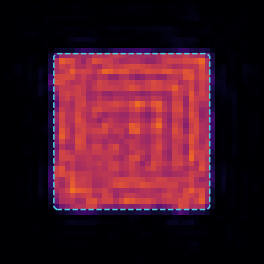
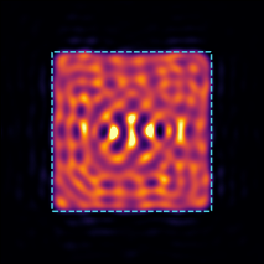
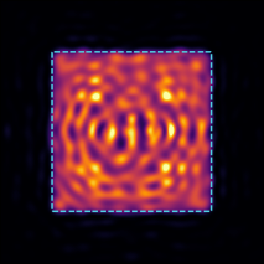
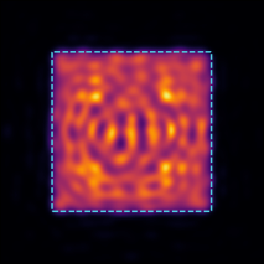
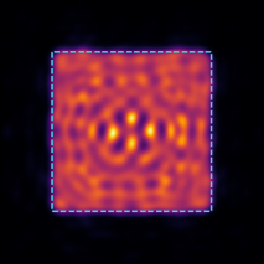
Perfect optics Whole beam on the SLM Real expander and Fourier Real source, M² 1.2 SLM corrects the optics uniformity 0.108 (clipping) lens uniformity 0.179 uniformity 0.169 uniformity 0.276 uniformity 0.262
Each map covers ±0.25 mm with the same colour scale. The dashed line is the target square. A uniformity in green is under the limit of 0.2, in red above it.