
Laser beam shaping · Glass cutting
Core size, zone length and axicon tip tolerance of a Bessel beam shaper for glass cutting
Ultrashort-pulse laser at 1030 nm, fused-silica axicon and a reducing telescope, after Balage et al.; wave-optics field computed plane by plane along the Bessel zone
Core size, zone length and axicon tip tolerance of a Bessel
beam shaper for glass cutting
Ultrashort-pulse laser at 1030 nm, fused-silica axicon and a reducing telescope, after Balage et al. [1];
wave-optics field computed plane by plane along the Bessel zone
| Application | Modelling approach |
| Glass is cut with ultrashort pulses focused into a Bessel | The Gaussian beam was propagated as a field through |
| beam: a narrow core that keeps its size over the whole | the axicon and the two telescope lenses. The axicon was |
| thickness of the sheet. The machine builder has to know | crossed by its exact radial ray map, the lenses as ideal |
| three things before buying the optics. How narrow is the | thin lenses. The field was read on planes every 12.5 to 40 |
| core, how long is the zone, and how much does an | μm along the zone. Real rays traced through a glass |
| imperfect axicon tip disturb it? | sheet give the length of the zone inside the glass. |
1 The shaper

Figure 1. The shaper in the 2D view of the App, PARAMETER VALUE laser on the left: the axicon turns the collimated Laser 1030 nm, Gaussian, beam radius 0.75 mm (1/e²) beam into a cone, the first lens focuses it into a Axicon Fused silica, 170° apex (5° base angle) ring, and the second lens forms the reduced Telescope f1 = 125 mm, f2 = 25 mm, reduction ×5 Bessel zone on the right, 30.3 mm after it. The drawing is to scale in both directions. Table 1. Cone half-angle 11.2° in air, 7.4° in glass Main parameters. Zone centre 30.32 mm after the second lens
2 The Bessel zone along the beam
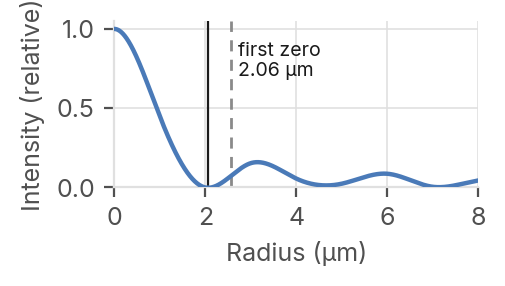
2.06 μm
Radius of the Bessel core at its first zero, at the centre of the zone. The cutting study
we follow measured 1.9 ± 0.66 μm [1].
0.61 mm
Length of the zone in air, where the on-axis
intensity stays above half its maximum. In a
glass of index 1.51, the zone grows to about
0.94 mm.
3.5 %
Share of the beam power inside the core at
the centre of the zone. The rest flows in the
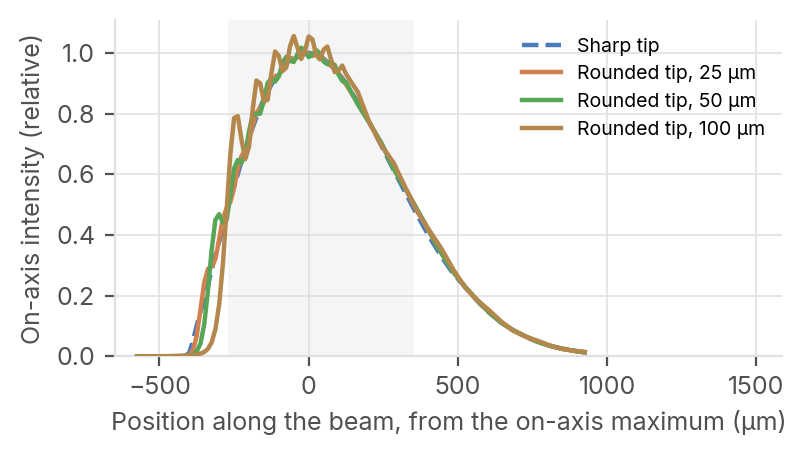
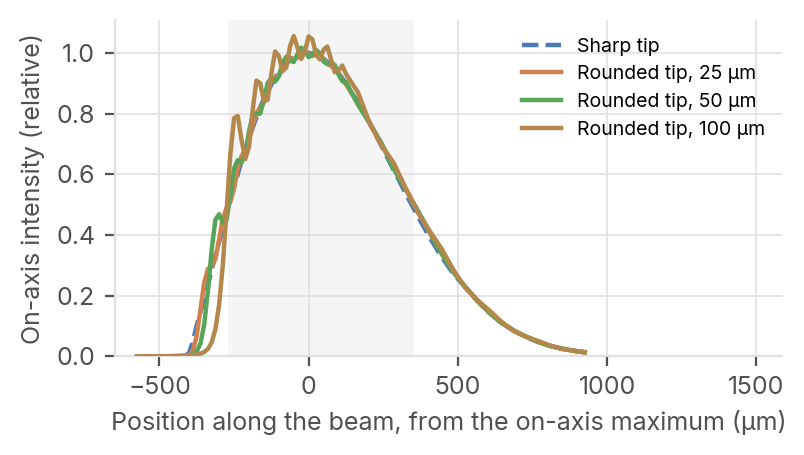
rings that feed the core along its length. Figure 2. Intensity on the axis along the zone, for a sharp axicon tip and for three rounded tips, relative to the maximum of the sharp tip. The grey band is the zone above half maximum with the sharp tip.
etendue.io 1030 nm · 170° fused-silica axicon · telescope 125 / 25 mm · etendue, October 2026
What glass the shaper cuts, and what axicon tip to accept
Table 2. Zone length against the glass to cut
Why a rounded tip modulates the
r^(B)a^(e)d^(a)iu^(m)s Zone in In glass Air length ≥ zone
Glass sheet (mm) air (mm) (mm) sheet The centre of a rounded tip acts as a weak alkali-free borosilicate, 0.3 mm 0.75 0.61 0.94 pass lens. Its light travels almost along the axis and beats with the cone, which gives fringes soda-lime, 1 mm 0.75 0.61 0.94 fail along the axis with a period of λ / (1 − cos θ) soda-lime, 1 mm 1.00 0.82 1.25 fail [2]. Zone length at half maximum of the on-axis intensity. In glass: the length in air
| times 1.53, from real rays traced through a soda-lime sheet. Judged in air | What to ask from the axicon |
| (conservative). | supplier |
| Table 3. Rounded axicon tips | ^(A)^(r)^(o)^(u)^(n)^(d)^(e)^(d)^(z)^(o)^(n)^(e)^(u)^(p)^(t)^(o)^(5)^(0)^(μ)^(m)^(a)^(c)^(r)^(o)^(s)^(s)^(t)^(h)^(e)^(t)^(i)^(p) |
keeps the on-axis intensity within 20 % of Rounded zone Apex radius Largest change in the Core radius Within 20 the sharp tip inside the zone. A rounded (μm) (mm) zone (%) (μm) % zone of 100 μm does not. A tolerance on the 0 (sharp) 0 0 2.06 pass tip belongs in the axicon specification. 25 0.29 3 2.08 pass
50 0.57 11 2.12 pass The ring focus inside the telescope
The first lens focuses the cone into a ring of 100 1.14 40 2.21 fail 4.9 mm radius, in air. Its peak irradiance is On-axis intensity against the sharp tip, plane by plane, inside the zone. The about 3 × 10⁴ times lower than in the core. rounded tip is a hyperboloid whose slope tends to that of the 5° cone [2, 3]. No ray crosses the axis inside the axicon: no focus in the glass of the optics.
Figure 3. Core profile, zone centre
In etendue
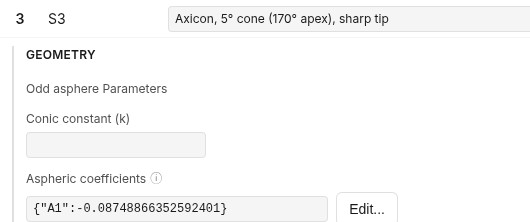
Dashed: largest radius accepted, 2.56 μm [1]. An ideal Bessel beam at the same cone angle has its first zero at 2.04 μm. Figure 4. The axicon cone in the surface table: an odd asphere whose only term is in r, A1 = −tan 5°. Library project « LAS11 – Bessel Beam Shaper for Glass Cutting »: Projects → Laser → Open, then Execute.
Conclusions. With a 0.75 mm beam, the shaper covers the 0.3 mm sheet with margin, and its core meets the published radius. The zone grows in proportion to the beam radius (0.61 mm at 0.75 mm, 0.82 mm at 1 mm, in air): a 1 mm soda-lime sheet needs a beam radius above 1 mm under the conservative criterion. The axicon tip should be specified: a rounded zone up to 50 μm is acceptable, 100 μm is not.
Limits of the study. Ideal thin lenses. The second lens is 25 mm instead of the 10 mm of [1], so the cone half-angle is 11° instead of 27°: at that angle, the zone would need a wave-optics grid beyond the memory budget of this study. Field computed in air, not in the glass; no process model.
References. [1] P. Balage et al., Bessel beam dielectrics cutting with femtosecond laser in GHz-burst mode, Micromachines 14, 1650 (2023). [2] O. Brzobohatý et al., High quality quasi-Bessel beam generated by round-tip axicon, Opt. Express 16, 12688 (2008). [3] S. Akturk et al., Intensity distribution around the focal regions of real axicons, Opt. Commun. 281, 4240 (2008). [4] D. McGloin, K. Dholakia, Bessel beams: diffraction in a new light, Contemp. Phys. 46, 15 (2005).