
Imaging optics · Tolerancing
Image contrast of a 36 mm f/2 imaging lens with imposed group tilts
Eleven-lens objective of patent US 8,879,901, three lens groups, 12 variants, polychromatic MTF at 50 cycles/mm
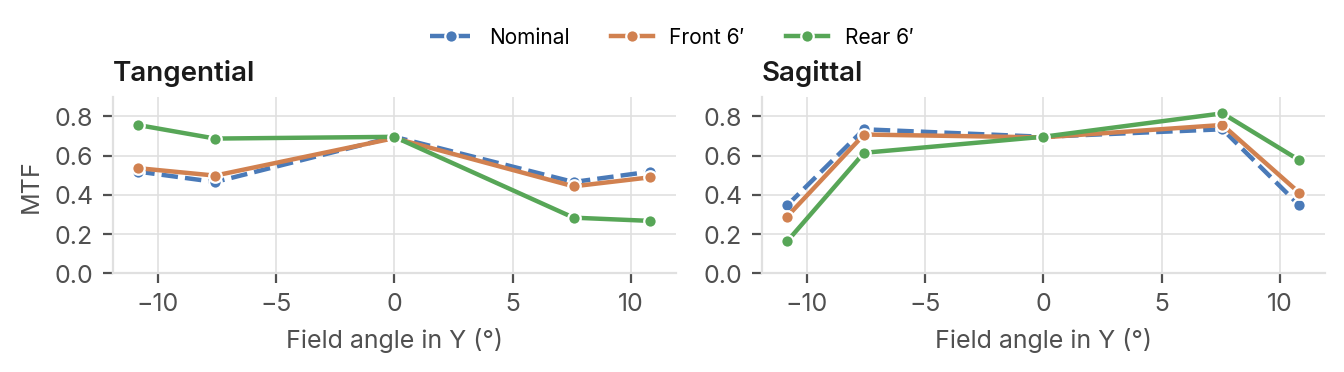
Image contrast of a 36 mm f/2 imaging lens with imposed
group tilts
Eleven-lens objective of patent US 8,879,901 [1], three lens groups, 12 variants, polychromatic MTF at
50 cycles/mm
| Application | Modelling approach |
| A tolerance analysis starts from an image quality budget | The lens was split into three groups. Each variant tilts |
| and returns the tilt that each lens group may take. The | one or two groups about the front vertex of their first |
| opposite question is just as common during assembly: | lens, and leaves every lens prescription and the image |
| the mount holds a group to a few arcminutes, so how | plane unchanged. The polychromatic MTF was |
| much contrast does the image lose? This note imposes | computed at seven field points, in +Y, −Y and ±X, |
| group tilts on an imaging lens and reads the image | because a tilt breaks the rotational symmetry of the lens. |
quality of each variant.
1 The lens and its groups
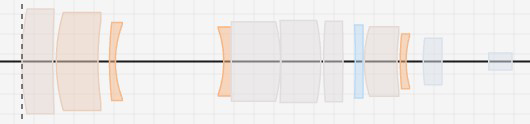
Figure 1. The lens as modelled: from left to right, the front group (three lenses), the stop, the rear group (the cemented doublet and six lenses) and the plane-parallel plate. Table 1. Main parameters and the three groups.
PARAMETER VALUE
Focal length, aperture 36.0 mm, f/2.0
| Half field | 10.82° |
| Wavelengths | 486.1, 587.6, 656.3 nm |
| Front group | L1 to L3, before the stop |
| Rear group | L4 to L11, after the stop |
| Doublet | L4-L5, inside the rear group |
2 Contrast lost with each imposed tilt
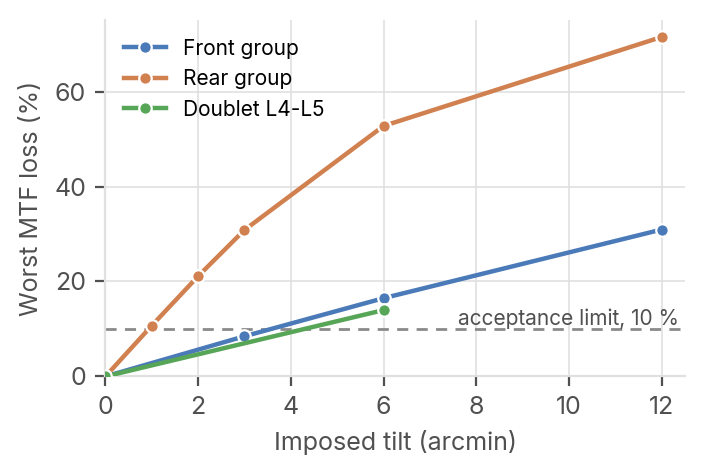
0.9′
Rear-group tilt at which the worst field point loses 10 % of its contrast. The front group
reaches the same loss at 3.6′.
−31 %
Contrast lost at −10.8° Y when the rear group
tilts by 3′, a tolerance often used for a lens
element [2]: from 0.35 to 0.24.
8 μm per arcmin
Image shift on axis for each arcminute of
rear-group tilt. The front group moves the
image by 2 μm per arcminute.
Figure 2. The largest loss of contrast over the seven field points and both orientations, at 50 cycles/mm, against the tilt imposed on one group. The dashed line is the acceptance limit of this study.
etendue.io 36 mm, f/2, ±10.82° · MTF at 50 cycles/mm, half the Nyquist frequency of a 5 μm pixel · etendue, October 2026
Where the contrast goes, and what the mount must hold
A tilted group tilts the image surface: one edge of the field gains contrast, the opposite edge loses it.
Table 2. Worst MTF of each variant, and image shift on
axis Why one edge loses
A tilted group tilts the image surface. One edge of Worst MTF Loss Image shift Within 10 Variant (nominal) (%) (μm) % the field moves towards best focus and gains contrast; the opposite edge moves away and loses it Front 3′ 0.32 (0.35) 8 +6 pass (Figure 3). The axis does not change. The field point Front 6′ 0.29 (0.35) 16 +12 fail at −10.8° Y, already the weakest of the nominal lens Front 12′ 0.24 (0.35) 31 +25 fail in sagittal, sets the verdict of almost every variant. Rear 1′ 0.31 (0.35) 11 -8 fail
Rear 2′ 0.27 (0.35) 21 -17 fail What the mount must hold
The front group stays within the limit up to about Rear 3′ 0.24 (0.35) 31 -25 fail 3.6′, so a 3′ mount tolerance [2] is enough. The rear Rear 6′ 0.16 (0.35) 53 -50 fail group exceeds it at 1′ and reaches it at about 0.9′. It Rear 12′ 0.10 (0.35) 72 -101 fail needs a tighter mount, or an adjustment of its tilt during assembly, as proposed for the camera of [3]. Doublet 6′ 0.45 (0.52) 14 -7 fail
Front +6′, rear −6′ 0.20 (0.35) 41 +63 fail For the doublet alone, the limit is about 4.3′, a linear estimate from a single tilt of 6′. Front +6′, rear +6′ 0.14 (0.35) 60 -38 fail
MTF at 50 cycles/mm. The worst point is −10.8° Y, sagittal, except for Combining tilts
Doublet 6′ (+10.8° Y, tangential) and Front +6′, rear −6′ (+10.8° Y, sagittal). Tilting both groups does not compensate. With The image shift is the position of the chief ray of the axial field on the image opposite tilts of 6′, the image shifts by +63 μm and plane, at 587.6 nm. loses 41 %. With tilts in the same direction, the shifts Limits of the study. Tilts are about X only, without decentre or refocusing; partly cancel (-38 μm), but the contrast loss grows the MTF is read at a single frequency; the 10 % limit and the 5 μm pixel are to 60 %. choices of this study, not values published for this lens.
Figure 3. MTF across the field in Y, nominal lens and 6′ group tilts
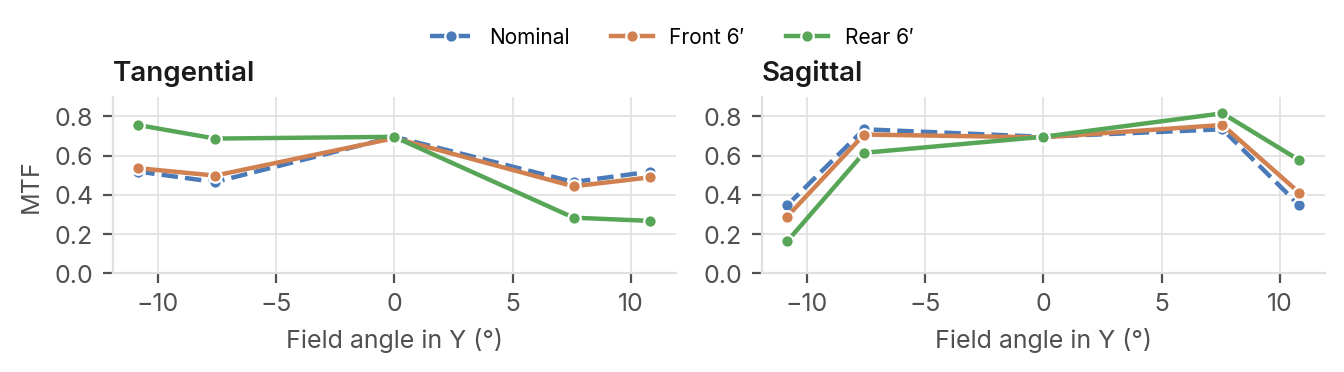
The rear-group tilt raises the contrast at one edge of the field and lowers it at the other; the front-group tilt does the same, about four times less.
In etendue

Figure 4. The front group in the surface table, variant « Front 6′ »: the group carries its element tilt, its lenses keep their values. Table view: Add a group, tick its lenses; type the tilt on the group header in each variant tab; run the MTF analysis on all variants.
References. [1] US 8,879,901. [2] S. Nam, tolerance analysis of a small camera lens, OPTI 521 report, College of Optical Sciences, University of Arizona. [3] E. Oliva et al., Concept and optical design of the cross-disperser module for CRIRES+, arXiv:1407.3057 (2014). [4] G. D. Boreman, Modulation Transfer Function in Optical and Electro-Optical Systems, SPIE Press (2001).