
Illumination and stray light
Total integrated scatter of a rough mirror, and Lambertian and ABg diffusers
The etendue non-sequential ray tracer compared with the Davies and Bennett-Porteus scatter law, the Lambertian view factors and the integral of the ABg model
Total integrated scatter of a rough mirror, and Lambertian
and ABg diffusers
The etendue non-sequential ray tracer compared with the Davies and Bennett-Porteus scatter law, the
Lambertian view factors and the integral of the ABg model
| The question | The reference |
| Does etendue scatter the right fraction of light, in the | For a moderately rough surface, the fraction scattered is |
| right directions? Stray-light and illumination studies rest | 1 − exp(−(4πσ cos θ/λ)²), after Davies and Bennett and |
| on it. The roughness of a polished mirror sets how much | Porteus, as written by Harvey et al. (2012, eq. 3). A |
| light leaves the specular beam, and the scatter law of a | Lambertian surface sends the fraction sin²θ of its light |
| diffusing surface sets where that light goes. | within an angle θ (Howell, cases B-12 and C-41). For the |
ABg model with g = 2, the fraction within sin θ = u is ln(1 + u²/B)/ln(1 + 1/B), the integral given by Freniere (2012).
1 The systems
A thin collimated beam strikes a flat mirror of known PART VALUE roughness, and the power left in the specular beam gives Rough mirror flat, σ = 1 to 40 nm, 1 000 rays, 400 / 550 / 1 064 the scatter. Then the same beam strikes a plate that nm, 0° / 30° / 60° reflects 80 % of the light diffusely, and a large detector Diffusing plate reflects 80% of the light, Lambertian or ABg records where the scattered light lands. Each diffuser is Beam on the plate collimated, 0.1 mm radius, normal incidence, 550 traced once with 200 000 rays; its noise is computed from nm the spread of the ray weights. Rays per diffuser 200 000
Detector plane at 20 mm (Lambertian) or 100 mm (ABg)
2 How far etendue is from the exact values
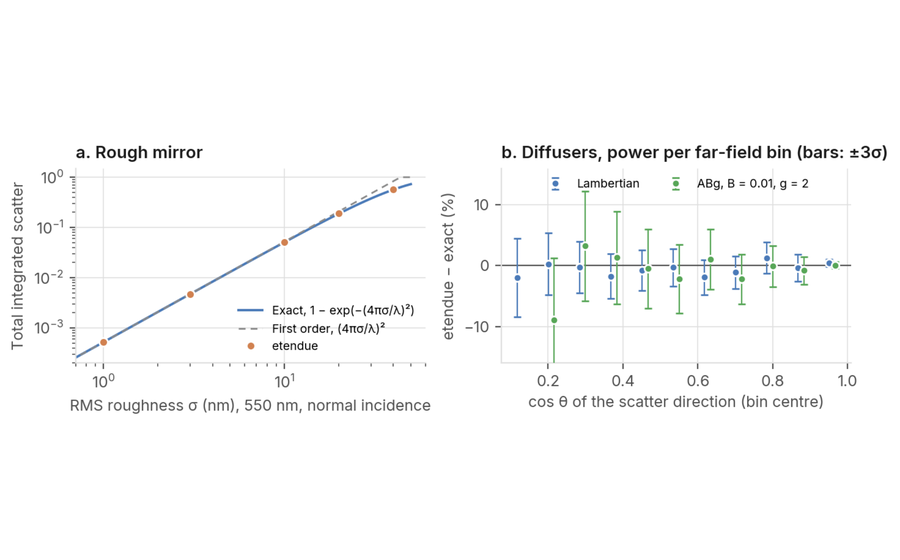
How close is the scatter? On every mirror, from 1 to 40 nm of roughness, etendue follows the exact law and not its first-order form, and the diffusers send their light where the exact laws do, within the random noise.
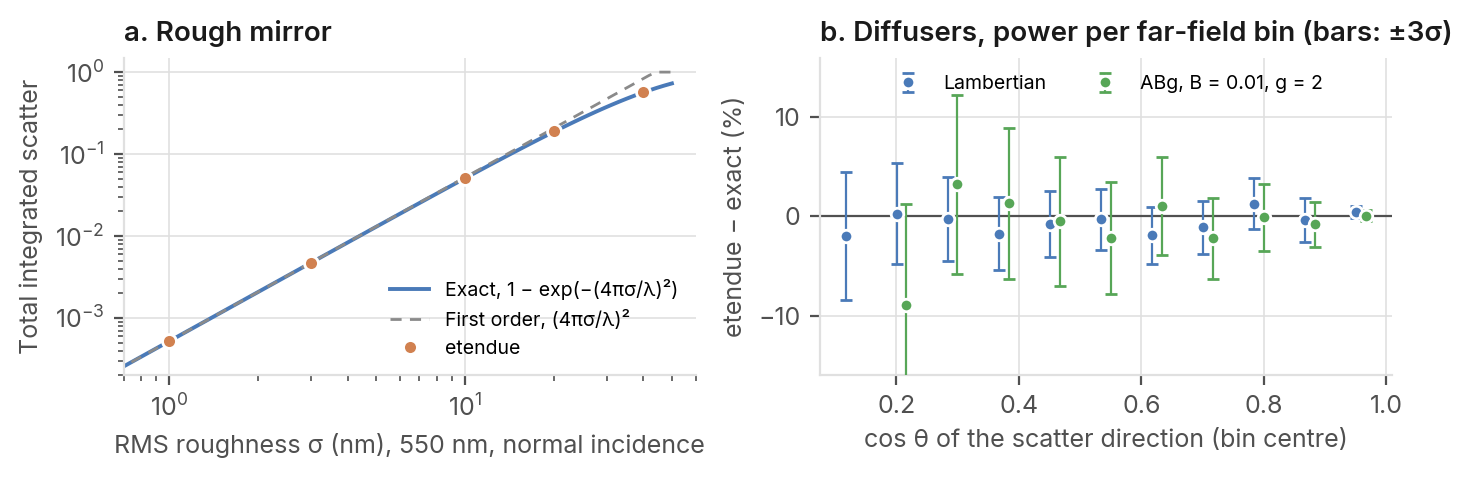
Figure 1. a. Fraction of light scattered by a flat mirror at 550 nm and normal incidence, against its RMS roughness. b. Relative difference between etendue and the exact power in each far-field bin of equal solid angle, for the two diffusers. Only the bins that the detector sees entirely are shown.
0.00% 2.6σ 0.7970 43 of 43
Largest error on the scatter of Largest difference from the Fraction of the source power Comparisons within the limits
| a rough mirror (σ = 1 to 40 | exact diffuser values, over 34 | scattered by the Lambertian | written before the |
| nm), over three wavelengths | Monte Carlo comparisons. All | plate. Exact: 0.8. | measurement. |
and three angles. lie within 3σ.
etendue.io References: Harvey et al., Opt. Eng. 51 (2012); Howell, Configuration Factors; Freniere (2012) · etendue, November 2026
The numbers, and what they do not say
Every comparison, the noise it was judged against, and the domain of the scatter law.
Table 2. Scatter of a flat mirror Table 3. Plate reflecting 80%, fractions of the source power
σ λ θ Diff. Quantity Exact etendue Diff. (%) Diff. / σ (nm) (nm) (°) Exact etendue (%) Lambertian, r ≤ 5 mm 0.0471 0.0472 +0.36 +0.8 met 1 550 0 0.0005219 0.0005219 −0.00 met Lambertian, r ≤ 10 mm 0.1600 0.1605 +0.31 +1.2 met 3 550 0 0.004687 0.004687 −0.00 met Lambertian, r ≤ 20 mm 0.4000 0.4006 +0.16 +0.5 met 3 550 30 0.003517 0.003517 −0.00 met Lambertian, r ≤ 40 mm 0.6400 0.6385 −0.23 −1.0 met 3 550 60 0.001174 0.001174 −0.00 met Lambertian, r ≤ 100 mm 0.7692 0.7664 −0.37 −1.9 met 3 400 0 0.008843 0.008843 +0.00 met ABg, r ≤ 2.5 mm 0.0105 0.0108 +3.08 +1.2 met 3 1064 0 0.001255 0.001255 −0.00 met ABg, r ≤ 5 mm 0.0386 0.0387 +0.20 +0.2 met 10 550 0 0.05086 0.05086 +0.00 met ABg, r ≤ 10 mm 0.1193 0.1189 −0.31 −0.5 met 20 550 0 0.1885 0.1885 −0.00 met ABg, r ≤ 25 mm 0.3344 0.3345 +0.03 +0.1 met 40 550 0 0.5662 0.5662 +0.00 met ABg, r ≤ 50 mm 0.5277 0.5280 +0.04 +0.3 met σ: RMS roughness; θ: angle of incidence. Limit: 1% of the ABg, r ≤ 100 mm 0.6816 0.6812 −0.05 −0.4 met exact value, a half-percent error on the roughness one Lambertian, bins (11) −2.0 to +1.3 −2.0 to +2.2 met would infer from it.
ABg, bins (10) −9.0 to +3.2 −2.6 to +1.1 met
| Lambertian, total | 0.8000 0.7970 | −0.37 | −1.3 met |
| ABg, total | 0.8000 0.7982 | −0.22 | −1.0 met |
r ≤ x: power landing within a radius x of the axis on the detector. A far-field bin spans 1/12 in cos θ. σ: Monte Carlo noise, from the spread of the ray weights; a value is met when it lies within 3σ.
| The domain of the scatter law | What this does not cover |
| etendue computes the fraction scattered by a rough mirror | The shape of the Harvey-Shack lobe, whose constants are |
| as 1 − exp(−(4πσ cos θ/λ)²), equation 3 of the reference, | internal, and the total scatter implied by the A coefficient of |
| which its authors give for moderately rough surfaces and | the ABg model: etendue takes the scattered fraction as an |
| hold accurate up to a scatter of about 0.9. Its first-order | input instead. Nor polarisation or diffraction of the scattered |
| form, (4πσ cos θ/λ)², is good to 1% only up to about λ/89 of | light. |
roughness, and would read 48% high at 40 nm. The
roughness entered is taken as the band-limited roughness How it was computed
Each scene is built and traced as the non-sequential editor relevant to scatter, the one the reference asks for; a total does it, with the options of the stray light analysis, and read roughness measured over a wider band would overstate the by the stray light and encircled energy analyses of etendue. scatter. No value was tuned. As a check of the power balance, the Lambertian plate absorbs 0.203 W of the 1 W it receives, for 0.2 W expected, and the balance closes to 3.5×10⁻¹⁶ W.
References
[1] J. E. Harvey, S. Schröder, N. Choi, A. Duparré, “Total integrated scatter from surfaces with arbitrary roughness, correlation widths, and incident angles”, Opt. Eng. 51(1), 013402 (2012), eqs. (1)-(4), after H. Davies, Proc. IEE 101 (1954), and H. E. Bennett, J. O. Porteus, J. Opt. Soc. Am. 51 (1961). [2] J. R. Howell, A Catalog of Radiation Heat Transfer Configuration Factors, 3rd ed., online, cases B-12 and C-41. [3] E. R. Freniere, “Insights into the ABg BSDF model”, technical note (2012), total scatter integral for g = 2.