
Laser thermal
Thermal lens of a laser-heated fused-silica element, checked against analytical solutions
1000 W Gaussian beam at 1064 nm, steady state, heat absorbed in the bulk or in a coating
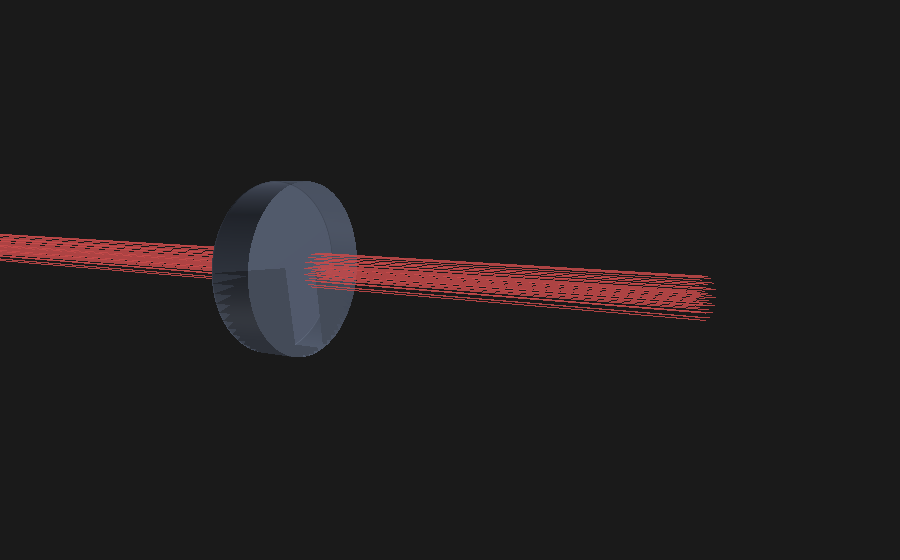
Thermal lens of a laser-heated fused-silica element,
checked against analytical solutions
1000 W Gaussian beam at 1064 nm, steady state, heat absorbed in the bulk or in a coating
| The question | The references |
| A laser beam that crosses a window or a lens leaves part | Hello and Vinet solved the heat equation in a cylinder |
| of its power in the glass. The glass warms and becomes | heated by a Gaussian beam, with linear heat losses on |
| a weak lens that moves the focus of the beam. This note | every face, as a series of Bessel functions [1]. They give |
| checks the temperature and the thermal focal length that | the temperature field for heat absorbed in the bulk and in |
| etendue computes against two published analytical | a coating, and the optical path added by dn/dT. Chénais |
models, for heat absorbed in the bulk or in a coating. The et al. give the focal length of a Gaussian heat deposit focal length agrees within 0.27 %. between insulated faces [2]. The cases keep the approximations of both below 10⁻⁴.
1 The elements and the beam
Table 1. Eleven heated elements, all in fused silica (conductivity 1.38 W/(m·K), the value used in [1]), each with flat faces. The beam is a Gaussian of radius w at 1/e². The bulk absorbs 50 or 100 ppm/cm; a coating absorbs a fixed share of the beam. Only the index change is counted, as in both references.
CASE ELEMENT BEAM RADIUS W HEAT LOSSES HEAT SOURCE REFERENCE
A1 to A5 Ø6 to Ø20 × 2 mm 0.5 to 2 mm faces insulated, edge at ambient bulk [2]
| B1 | Ø600 × 200 mm | 20 mm | h = 4.90 W/(m²·K), all faces | bulk | [1] eq. (26), (29) |
| B2 | Ø50 × 10 mm | 5 mm | h = 10 W/(m²·K), all faces | bulk | [1] eq. (26), (29) |
| C1 | Ø600 × 200 mm | 20 mm | as B1 | coating, 0.1 % | [1] eq. (8), (29) |
| C2 | Ø50 × 10 mm | 5 mm | as B2 | coating, 0.01 % | [1] eq. (8), (29) |
| D1, D2 | Ø4, Ø6 × 2 mm | 2 mm | as A | bulk, beam clipped | Gaussian, [1] eq. (9) |
2 Agreement with the references
Does etendue reproduce the published temperature and focal length? Yes, at the default mesh of the analysis. The small difference that remains comes from the mesh: twice as fine in each direction, it falls below 0.04 %.
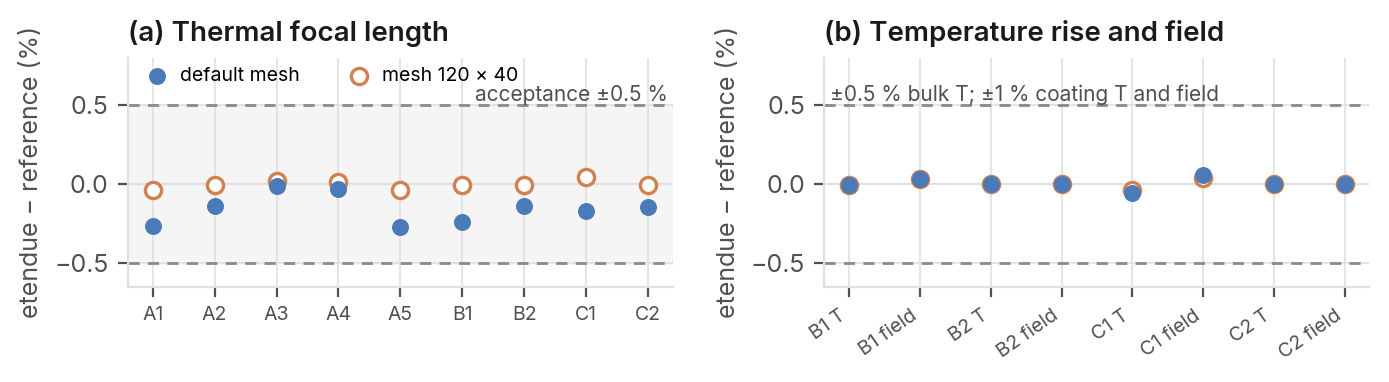
Figure 1. Difference to the reference of (a) the thermal focal length and (b) the temperature rise: at the centre (bulk heating) or the hot spot (coating), and the largest difference over the field, as a share of the peak rise. Filled: default mesh. Open: twice as fine in each direction.
| 19/19 | 0.27 % | 0.06 % | 3.1·10⁻⁸ |
| Comparisons within the | Largest focal-length | Largest temperature | Relative difference of the |
| criterion written before the | difference at the default | difference, at the centre, at | power clipped by the aperture |
| measurement. | mesh, 0.04 % on a finer | the hot spot or anywhere in | of the element. |
mesh. the element.
etendue.io Thermal lens computed by the laser thermal analysis of etendue · etendue, November 2026
What was compared, and where it holds
Temperature, field and focal length for bulk and coating heating; power lost at the aperture.
Table 2. Focal length and temperature rise, default mesh
FOCAL How etendue computes it
FOCAL LENGTH, RISE, RISE, The analysis finds the power each element ABSORBED LENGTH, ETENDUE DIFF. REF. ETENDUE DIFF. absorbs, in the bulk and in its coatings, solves
CASE (W) REF. (M) (M) (%) (K) (K) (%)
the steady heat equation of the element in
A1 0.02 5.5 5.5 −0.27 — — —
radius and depth by finite elements, and traces
A2 0.02 22.1 22.1 −0.14 — — —
the beam through the resulting index field. The A3 0.02 88.5 88.5 −0.01 — — — focal length is read from the curvature of the optical path on the axis, the quantity both
A4 0.02 22.1 22.1 −0.03 — — —
references give. The beam radius in the element
A5 0.02 22.1 22.1 −0.27 — — —
is updated from the heated state until it no B1 1 -201.4 -200.9 −0.24 1.770 1.770 −0.0056 longer changes; here one or two passes suffice.
B2 0.1 113.8 113.7 −0.14 3.690 3.690 +0.0001
Domain of validity
C1 1 -207.9 -207.6 −0.17 13.070 13.062 −0.0590
Steady state, symmetric about the axis, with a
C2 0.1 114.9 114.7 −0.15 6.830 6.830 −0.0001
constant dn/dT and linear heat losses. The
| B1 and C1 use the dn/dT of [1], which is negative, hence a diverging thermal | references count only the index change: the |
| lens. The temperature rise is taken at the centre (B), at the hot spot on the | stress and bulging terms that etendue also |
coated face (C). computes were not compared, for lack of published values. Nor was the default heat loss
Table 3. Power clipped by the aperture (convection and radiation): the cases set the
APERTURE CLIPPED, REF. CLIPPED, REL. losses of each reference. Heated mirrors are CASE RADIUS / W (W) ETENDUE (W) DIFF. not covered.
D1 1 135.3353 135.3353 1.4·10⁻⁸
D2 1.5 11.1090 11.1090 3.1·10⁻⁸ Mesh
The default mesh has 60 radial and 20 axial For a Gaussian beam the power outside a disc of radius a is P·exp(−2a²/w²). intervals, with layers tightened towards a
Table 4. Focal-length difference against the mesh (%) heated coating. For the three cases of Table 4,
on every mesh, the focal length stays within
MESH B1, BULK C1, COATING C2, COATING
0.24 % of the reference. Two effects remain. 60 × 20 −0.24 −0.17 −0.15 The beam crosses the lens it creates, which the 60 × 40 −0.24 −0.20 −0.14 references leave out: it moves the focal length of the two 200 mm parts by up to 0.07 %. 60 × 80 −0.24 −0.20 −0.14 Without it, the finest mesh leaves up to 0.05 % 60 × 100 −0.24 −0.20 −0.14 where the field matches to 1.4·10⁻⁷: the floor of 120 × 20 −0.00 +0.07 −0.01 the focal-length reading.
| 240 × 20 | +0.05 | +0.13 | +0.02 |
| 400 × 100 | +0.05 | +0.10 | +0.03 |
| Radial × axial intervals. 60 × 20 is the default of the analysis; the finest mesh it | Conclusions |
| accepts is 400 × 100. | For heat absorbed in the bulk or in a coating, |
etendue reproduces the published steady-state temperature and the thermal focal length of a laser-heated fused-silica element within 0.27 % at its default mesh, across element sizes from a few millimetres to 60 cm and focal lengths from 5 m to 200 m. The remaining difference comes from the mesh.
References. [1] P. Hello, J.-Y. Vinet, Analytical models of thermal aberrations in massive mirrors heated by high power laser beams, J. Phys. France 51, 1267-1282 (1990), eq. (6)-(10), (26), (29). [2] S. Chénais, F. Druon, S. Forget, F. Balembois, P. Georges, On thermal effects in solid- state lasers: the case of ytterbium-doped materials, Progress in Quantum Electronics 30, 89-153 (2006), eq. (III.16)-(III.18) and p. 51.