
Sequential ray tracing
Ray tracing of a 600 lines/mm Littrow spectrograph against the grating equation
Plane reflection grating, 200 mm achromatic doublet used twice, 625 to 680 nm
Ray tracing of a 600 lines/mm Littrow spectrograph against
the grating equation
Plane reflection grating, 200 mm achromatic doublet used twice, 625 to 680 nm
| The question | The references |
| Does etendue trace a reflection grating right? A | The grating laws are those of the Diffraction Grating |
| spectrograph puts a grating, a camera lens and a | Handbook [1]. They are exact, so the comparison is |
| detector in a folded path. The grating sends each | numerical. The doublet is a catalogue part whose focal |
| wavelength in its own direction, and the lens turns that | length and back focal distance are printed on its public |
direction into a position on the detector. This note checks drawing [2]. The instrument is a published amateur both steps against published values. spectrograph, with a dispersion given in its user guide [3] and measured by C. Buil [4].
1 The system, as the reference describes it
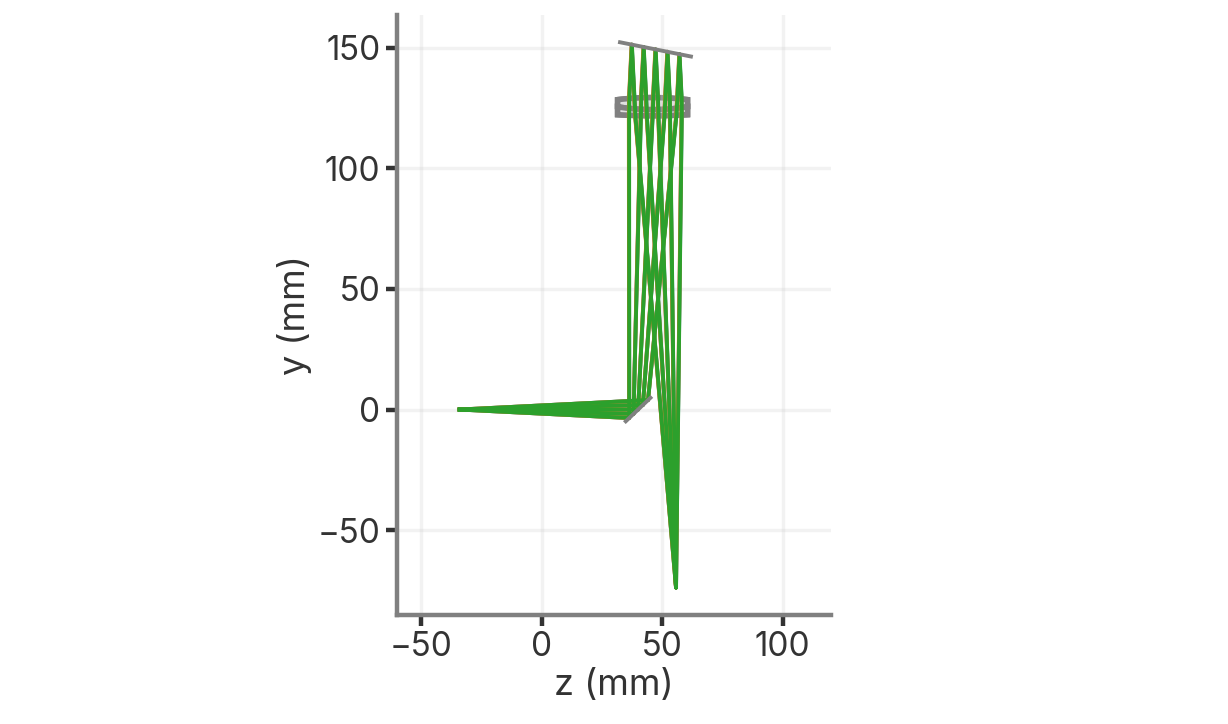
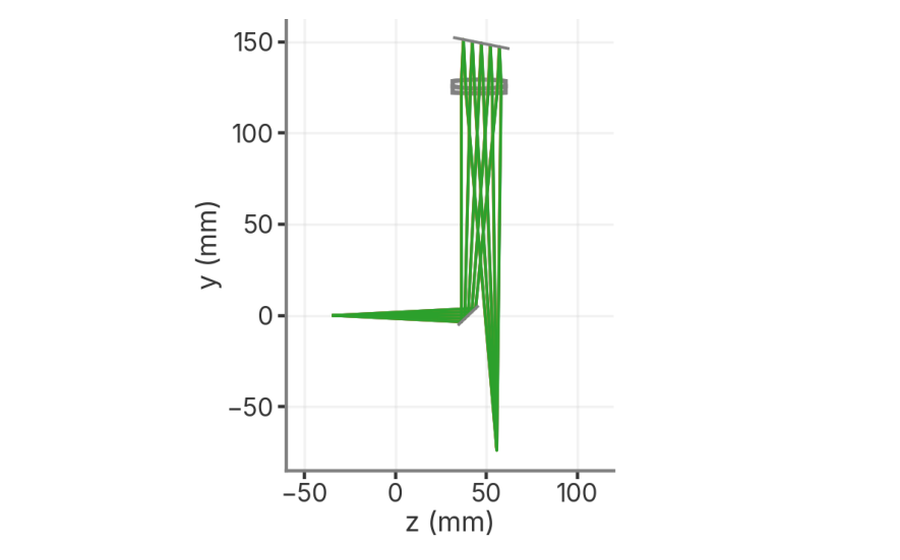
Figure 1. The modelled spectrograph, traced by etendue at 656.3 nm. Light from the slit (left) is folded by a flat mirror, collimated by the doublet, diffracted by the grating (top) and focused back through the same doublet onto the detector (bottom). Table 1. Main parameters.
| PARAMETER | VALUE |
| Grating | 600 lines/mm, plane, reflection |
Camera and collimator achromatic doublet, 200 mm, 30 mm diameter
| Wavelengths | 625, 640, 656.3, 670, 680 nm |
| Aperture, slit | f/10, slit centre and both ends |
| Angles at 656.3 nm | incidence 8.59°, diffraction 14.15° |
| Detector pixel | 9 μm |
2 How close etendue comes 9 of 12 agreement criteria met
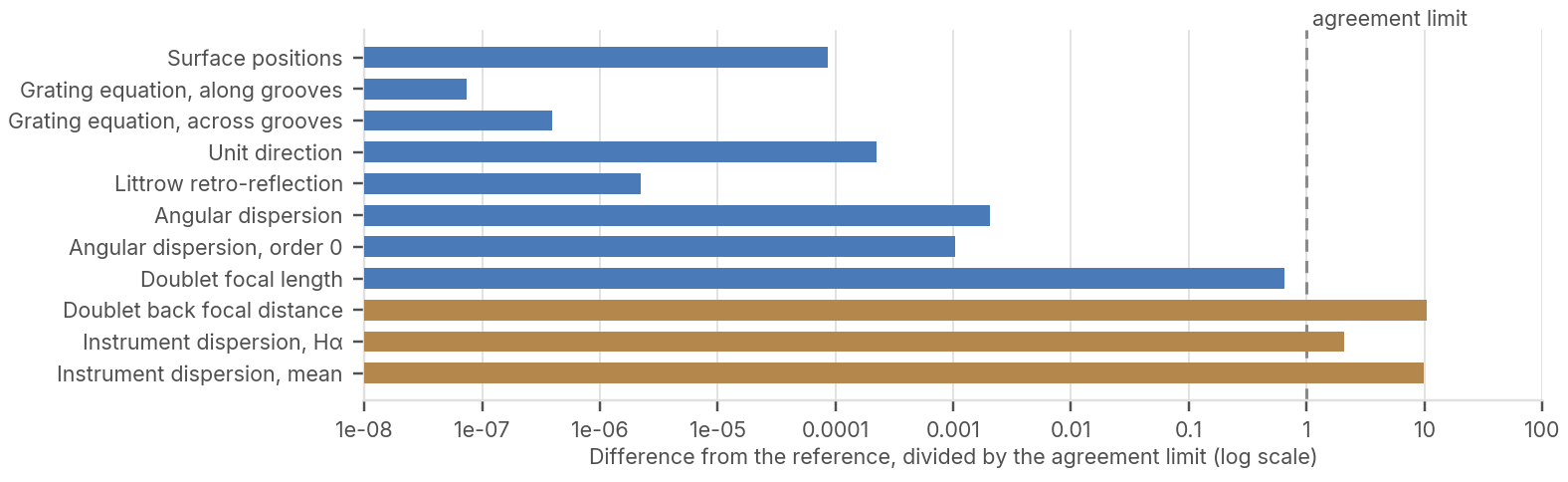
etendue meets 9 of the 12 agreement criteria. Every exact law of the grating holds to within rounding of double-precision arithmetic, and the doublet focal length matches its drawing. The three misses are on numbers that the published prescription cannot reproduce, as explained on page 2. Figure 2. Each difference divided by its agreement limit; a bar left of the dashed line meets the criterion.
3.9 × 10⁻¹⁶ 200.003 mm 0.0730 nm
Largest error on the grating equation over Focal length of the doublet. The drawing Dispersion per pixel at Hα. The user
9,765 rays, five wavelengths and three prints 200.00 mm. guide gives 0.074 nm for a design that
orders. works closer to Littrow.
What was compared, and how close
Table 2. Quantities compared with the reference, and the agreement limit written before the measurement
Quantity Reference etendue Difference Agreement limit Verdict
| Surface positions against the drawing (mm) | 0 | 8.5 × 10⁻¹⁴ 8.5 × 10⁻¹⁴ | 1.0 × 10⁻⁹ met |
| Direction change along the grooves, 9,765 rays | 0 | 7.3 × 10⁻¹⁷ 7.3 × 10⁻¹⁷ | 1.0 × 10⁻⁹ met |
| Direction change across the grooves minus mλ/d, same rays | 0 | 3.9 × 10⁻¹⁶ 3.9 × 10⁻¹⁶ | 1.0 × 10⁻⁹ met |
Unit length of the diffracted direction 1 1 ± 2.2 × 10⁻¹⁶ 2.2 × 10⁻¹⁶ 1.0 × 10⁻¹² met
Return on itself at Littrow, λ = 497.7 nm 0 2.2 × 10⁻¹⁵ 2.2 × 10⁻¹⁵ 1.0 × 10⁻⁹ met
Orders that propagate, m = −6 to +6, five wavelengths 65 cases 65 of 65 match 0 mismatch exact met
| Angular dispersion, orders ±1, relative difference | 0 | 2.0 × 10⁻⁹ 2.0 × 10⁻⁹ | 1.0 × 10⁻⁶ met |
| Angular dispersion, order 0 (mrad/nm) | 0 | 1.0 × 10⁻¹² 1.0 × 10⁻¹² | 1.0 × 10⁻⁹ met |
| Doublet focal length at 587.6 nm (mm) | 200.00 | 200.0032 | +0.0032 | ±0.005 met |
| Doublet back focal distance at 587.6 nm (mm) | 196.57 | 196.5174 | -0.0526 | ±0.005 not met |
| Instrument dispersion at Hα (nm per 9 μm pixel) | 0.074 | 0.0730 | -0.0010 | ±0.0005 not met |
| Instrument dispersion, 625–680 nm mean (Å per pixel) | 0.735 | 0.7301 | -0.0049 | ±0.0005 not met |
Grating laws: the direction of each ray just before and just after the grating, read in the grating frame. Agreement limits are numerical for exact laws and half the last printed digit for published values.
Table 3. Where the instrument dispersion of the
Why the back focal distance misses model comes from (reciprocal dispersion at Hα)
etendue gives 196.517 mm, and an independent paraxial Step Factor nm/mm matrix calculation with the same indices gives the same Grating law in exact Littrow, 200 mm — 8.1702 value to 10⁻¹³ mm. Moving every radius and thickness of the camera drawing by half its last printed digit keeps it between 196.502 Diffraction angle 14.15° instead of 11.36° 0.98901 and 196.533 mm. The drawing does not say how its 196.57 (Littrow) mm is defined. One reading gives both printed numbers: the focal length at 587.6 nm (200.003 mm) with the back focal Doublet focal length at 656.3 nm, 200.14 0.99931 mm distance to the mean paraxial focus of the F, d and C lines, which etendue gives as 196.570 mm. No single wavelength Off-axis angle in the camera, 2.80° 0.99762 and no real-ray best focus at 587.6 nm does. This match is Real ray trace against first order (detector 1.00643 consistent, not proven; the criterion keeps the single- focus, distortion) wavelength definition written before the measurement. Product of the factors, and the value 0.99232 8.1075
Why the instrument dispersion misses^(e)^(t)^(e)^(n)^(d)^(u)^(e)^(t)^(r)^(a)^(c)^(e)^(s)
Reciprocal linear dispersion, Palmer equation (2-17). The first four The real instrument lens is not published, nor the angle factors are measured by etendue on the model; the last is what between its incoming and outgoing beams (the guide only remains between real rays and first-order optics. says the instrument works slightly off axis), so the model replaces the lens with the catalogue doublet and separates
the slit from the detector. The model then works 2.80° off the References
- C. Palmer, Diffraction Grating Handbook, 8th edition (2020), Littrow angle, which lowers the dispersion by 0.77 %. The full chapter 2, pp. 21–28, equations (2-1) to (2-17). difference is accounted for by four factors that etendue
- Public drawing of the 30 mm × 200 mm achromatic doublet, measures itself: the angle off Littrow, the doublet focal length catalogue part 45-415, note 7 (focal length and back focal at 656.3 nm, the off-axis angle in the camera and the distance). detector position. An independent tracer reproduces the
- User guide of the spectrograph, ref. DC0004A, O. Thizy and detector positions to 7.8 × 10⁻¹⁴ mm. The miss belongs to the F. Cochard (December 2006), p. 7. model of the instrument, not to the ray tracing. 4. C. Buil, test of the spectrograph with a 600 lines/mm grating, night of 14 November 2006,
Domain of validity buil.astrosurf.com/test600/eval_en.htm.
This is geometrical ray tracing of directions and positions. Grating efficiency, order intensities and resolving power are not compared: none is published for this grating.