
Ultrafast lasers
Femtosecond pulse in a glass window
Dispersion, B-integral and Kerr lens against published data
Dispersion, B-integral and Kerr lens of a femtosecond
pulse in a glass window, compared with published data
Fused silica and N-BK7 windows, 10 mm thick, at 800 and 1030 nm, with Gaussian and sech² pulses of
20 to 300 fs
| Question | Reference and method |
| Does etendue compute correctly how a femtosecond | A flat window is the simplest system for which each of |
| pulse spreads in time and picks up nonlinear phase in | these quantities has an exact answer. The refractive |
| glass? Ultrafast laser designers read the dispersion, the | index comes from the published dispersion formulas of |
| output duration and the B-integral of each element to | fused silica [1] and N-BK7 [2], and the nonlinear index |
| decide where to compress the pulse and how much | from femtosecond Z-scan measurements [3]. The critical |
| energy a lens can take. This note compares these | power, the Kerr phase of a Gaussian beam and the |
| numbers with values that follow from published material | spectral broadening follow published closed-form results |
| data and closed-form results. | [4–6]. The reference values are computed from these |
formulas, outside etendue. The agreement criteria were set before the first measurement.
1 The system
PARAMETER VALUE PARAMETER VALUE
| Window | 10 mm, flat faces, 25.4 mm diameter | Beam | Gaussian, 1.0 mm radius at 1/e², waist on the entrance face |
| Glasses | fused silica [1], N-BK7 [2] | Pulses | Gaussian 20–300 fs, sech² 300 fs, transform-limited |
Wavelengths 800 and 1030 nm Energies 1 pJ (linear), 51–701 μJ (nonlinear)
Table 1. The window and the source, as entered in etendue in laser mode. Air follows the window up to the image plane, 10 mm away.
2 Deviation of each quantity from its reference
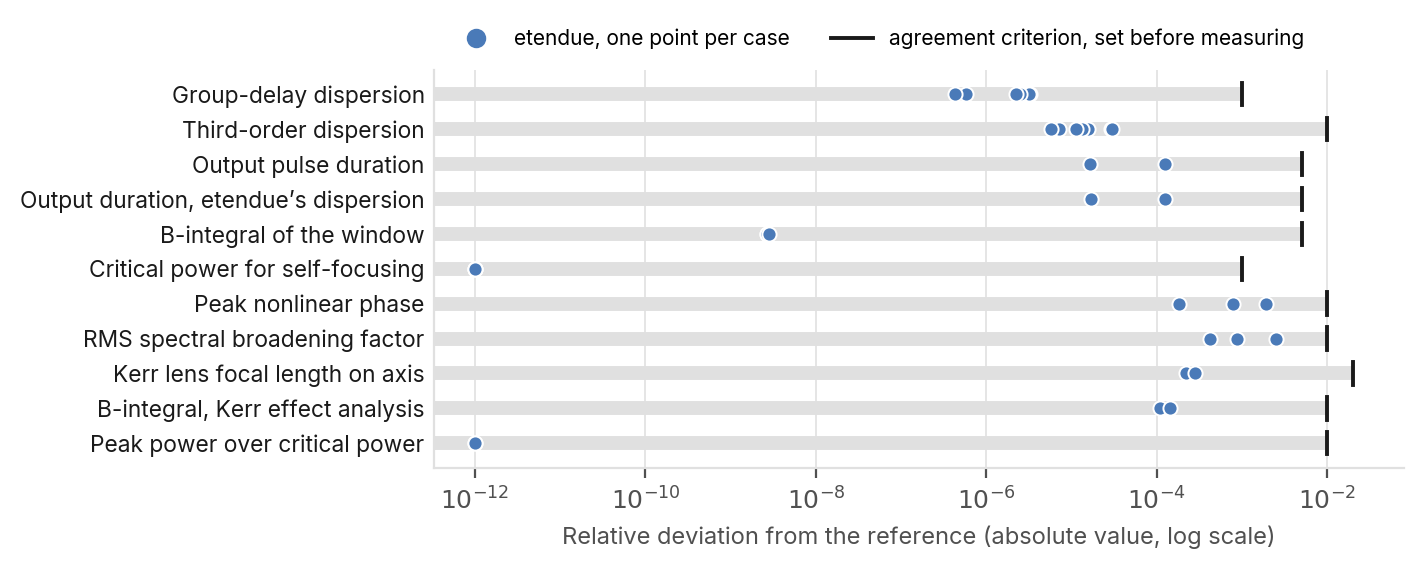
Figure 1. Relative deviation of etendue from the reference, one point per case, against the agreement criterion of each quantity (black tick). Points at 10⁻¹² or below agree to machine precision. Cases and values: Table 2.
| 38 / 38 | +3.2×10⁻⁶ | 0.25% | 0.03% |
| Quantities within the | Largest relative deviation of | Largest deviation of all: | Kerr lens focal length of the |
| agreement criterion written | the group-delay dispersion, | spectral broadening by self- | window, against the parabolic |
| before the measurement. | both glasses, both | phase modulation at B = 1.9 | Kerr phase of a Gaussian |
wavelengths. rad, for a criterion of 1%. beam.
etendue.io Fused silica and N-BK7, 10 mm · 800 and 1030 nm · 20–300 fs · etendue, November 2026
Results against the published references
38 of 38 quantities and 8 of 8 set-up checks within their criteria
Table 2. Deviation by quantity, all cases
LARGEST Verdict
QUANTITY VALUES DEVIATION CRITERION VERDICT All 38 quantities meet the criteria written Group-delay dispersion 8 +3.2×10⁻⁶ 0.1% met before the measurement, and so do the 8 set-up checks (nonlinear index read by Third-order dispersion 8 +3.0×10⁻⁵ 1% met etendue, peak power of the pulse). The Output pulse duration 2 +1.3×10⁻⁴ 0.5% met margin to the criterion ranges from a Output duration, etendueʼs dispersion 2 +1.3×10⁻⁴ 0.5% met factor of 4, for the spectral broadening at B = 1.9 rad, to six orders of magnitude for B-integral of the window 3 −2.8×10⁻⁹ 0.5% met the B-integral. Critical power for self-focusing 3 < 10⁻¹⁴ 0.1% met
| Peak nonlinear phase | 3 −1.9×10⁻³ | 1% met | What the agreement does not |
| RMS spectral broadening factor | 3 −2.5×10⁻³ | 1% met | show |
| Kerr lens focal length on axis | 2 −2.8×10⁻⁴ | 2% met | The critical power and the ratio of peak |
power to critical power agree to machine B-integral, Kerr effect analysis 2 +1.4×10⁻⁴ 1% met precision because etendue applies the Peak power over critical power 2 < 10⁻¹⁴ 1% met same formula as [4]. This checks the
| Deviation = (etendue − reference) / reference, largest over the cases. Cases: | index, the nonlinear index and the |
| dispersion for each glass at 800 and 1030 nm (1 pJ); duration of 20 and 50 fs pulses | wavelength that go into it, not the physics |
| after the silica window at 800 nm, third-order dispersion compensated at the input; B- | of self-focusing. |
integral and critical power at B = 0.5 rad in three windows; self-phase modulation of a The nonlinear index is the femtosecond 300 fs pulse at B = 0.5, 1.0 and 1.9 rad; Kerr lens for two of these windows. Values: value of [3] at 1030 nm. At 800 nm one per case and per path (material and traced dispersion count twice). etendue interpolates between the 772 and
Table 3. Dispersion of the 10 mm window 1030 nm values of [3] (2.09×10⁻²⁰ m²/W
for fused silica). The Kerr quantities at GDD, ref. Material Traced TOD, ref. Material Traced 800 nm check the formulas, not that 10 mm window (fs²) (fs²) (fs²) (fs³) (fs³) (fs³) value. silica, 800 nm 361.620 361.621 361.620 274.97 274.98 274.97 The pulse also crosses 10 mm of air silica, 1030 nm 189.726 189.726 189.725 411.47 411.48 411.48 before the image plane. Both etendue and N-BK7, 800 nm 446.518 446.519 446.518 321.01 321.02 321.02 the reference count it as dry air at 20 °C N-BK7, 1030 nm 251.223 251.224 251.222 455.22 455.23 455.23 (0.21 fs² at 800 nm; reference from [7]). The 20 fs pulse then deviates by etendue gives each value twice: from the derivatives of the material index, and from +1.7×10⁻⁵. the phase of the traced ray at five frequencies.
^(R)^(e)^(f)^(e)^(r)^(e)^(n)^(c)^(e)^(s)^(.)^([)^(1)^(])^(I)^(.)^(H)^(.)^(M)^(a)^(l)^(i)^(t)^(s)^(o)^(n)^(,)^(J)^(.)^(O)^(p)^(t)^(.)^(S)^(o)^(c)^(.)^(A)^(m)^(.)^(5)^(5)^(,)^(1)^(2)^(0)^(5)^(()^(1)^(9)^(6)^(5)^())^(,)^(d)^(i)^(s)^(p)^(e)^(r)^(s)^(i)^(o)^(n)^(f)^(o)^(r)^(m)^(u)^(l)^(a)^(i)^(n) Limits of validity the abstract. [2] SCHOTT, optical glass data sheets (2017-01-20), N-BK7, constants of The references assume a beam that does dispersion. [3] S. R. Flom et al., Appl. Opt. 54, F123 (2015), Table 1. [4] G. Fibich, A. L. Gaeta, Opt. Lett. 25, 335 (2000), Table 1, Pcr = 1.8962 λ²/(4π n₀ n₂). [5] M. Sheik- not self-focus. With a 50 μm waist at 0.2 times the critical power, the Kerr effect Bahae et al., IEEE J. Quantum Electron. 26, 760 (1990), Eqs. (5)–(6): on-axis Kerr phase
| k n₂ I₀ L of a Gaussian beam, whose parabolic expansion gives the Kerr lens. [6] S. C. | analysis follows the narrowing beam and |
| Pinault, M. J. Potasek, J. Opt. Soc. Am. B 2, 1318 (1985): RMS spectral width after self- | gives a B-integral 1.9% higher and a Kerr |
| phase modulation, (1 + 4B²/3√3)^(½), as quoted by C. Finot et al., J. Opt. Soc. Am. B 35, | focal length 3.0% shorter than the linear |
| 3143 (2018), Sec. 3, and re-derived here by numerical integration. [7] P. E. Ciddor, | reference. The pulse analysis keeps the |
| Appl. Opt. 35, 1566 (1996), dry air. The broadening of a Gaussian pulse by group-delay | linear beam and warns that its B-integral |
| dispersion and the dispersion orders β₂, β₃ are exact derivatives of the index, | is low by about 3.3%. No published value |
| computed with 40-digit arithmetic. | was available to judge this case. |
Not compared, for lack of a closed-form reference: the output duration with third- order dispersion, a dispersed sech² pulse, and the self-focusing distance.
etendue.io Laser pulse and Kerr effect analyses of etendue, laser mode · reference values computed outside etendue from the published
formulas