
Thermal
Thermal focus drift of a glass lens, checked against published glass data
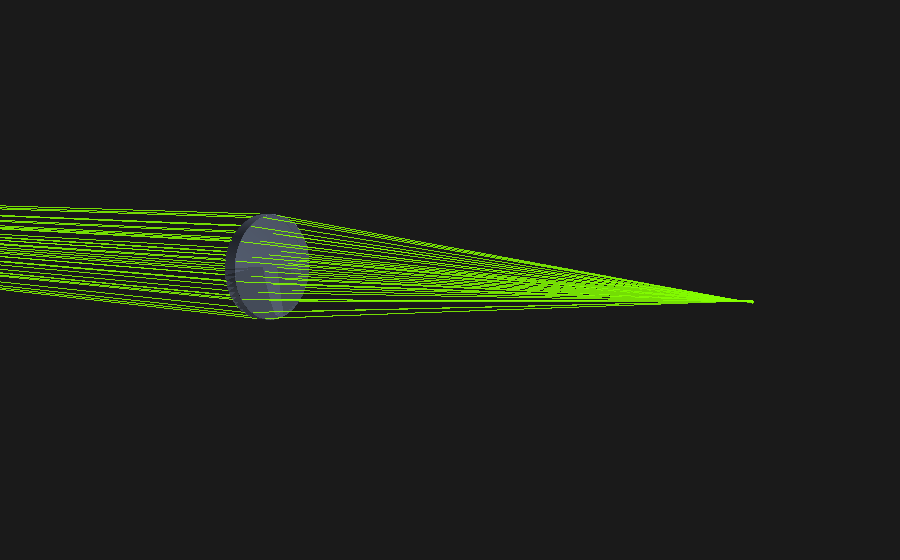
N-BK7 plano-convex lens, f = 100 mm at f/4, three wavelengths, −40 to +80 °C, two mount materials
Thermal focus drift of a glass lens, checked against
published glass data
N-BK7 plano-convex lens, f = 100 mm at f/4, three wavelengths, −40 to +80 °C, two mount materials
| The question | The reference |
| When the temperature of a lens changes, its glass index, | The glass maker publishes the temperature coefficients |
| its curvatures and the length of its mount all change, and | of the index of its glasses, with the formula and |
| the focus moves. This note checks the value etendue | constants behind them [1, 2]. The focus of a lens in a |
| computes against the temperature coefficients the glass | mount follows a first-order law [3], quoted here from [4]. |
| maker publishes and against the published first-order | For a plano-convex lens with its flat face towards the |
| law of thermal defocus, applied without approximation to | image, that law is exact at first order, so the reference |
| a thick N-BK7 lens. Over 18 cases, the computed focus | adds no thin-lens approximation. Only the rounding of |
| drift stays within 0.255 μm of the reference. | the datasheet limits it, to ±0.29 μm over 20 K. |
1 The lens
Table 1. The lens of the study, as loaded in etendue. The image plane sits at the paraxial focus at 546.1 nm and 20 °C. Lens and mount start at the same temperature and change together.
| PARAMETER | VALUE | PARAMETER | VALUE |
| Lens | Plano-convex, N-BK7 | Radius of the curved face | 51.872 mm |
| Centre thickness | 4 mm | Focal length at 546.1 nm | 100.000 mm |
| Entrance pupil | 25 mm (f/4) | Lens to image plane | 97.3662 mm |
| Wavelengths | 1060.0, 546.1, 435.8 nm | Mount expansion, ULE / Al 6061 | 0.03 / 23.6·10⁻⁶/K |
2 Focus drift against the reference
How far does the focus move when the lens warms by 20 K, and does etendue agree with the published law? With a mount that does not expand (ULE), the focus moves by a few micrometres, set by the glass alone. With an aluminium mount, the mount dominates and the image plane moves about 43 μm away from the focus. In both cases etendue stays within the ±0.30 μm that the rounding of the published data allows.
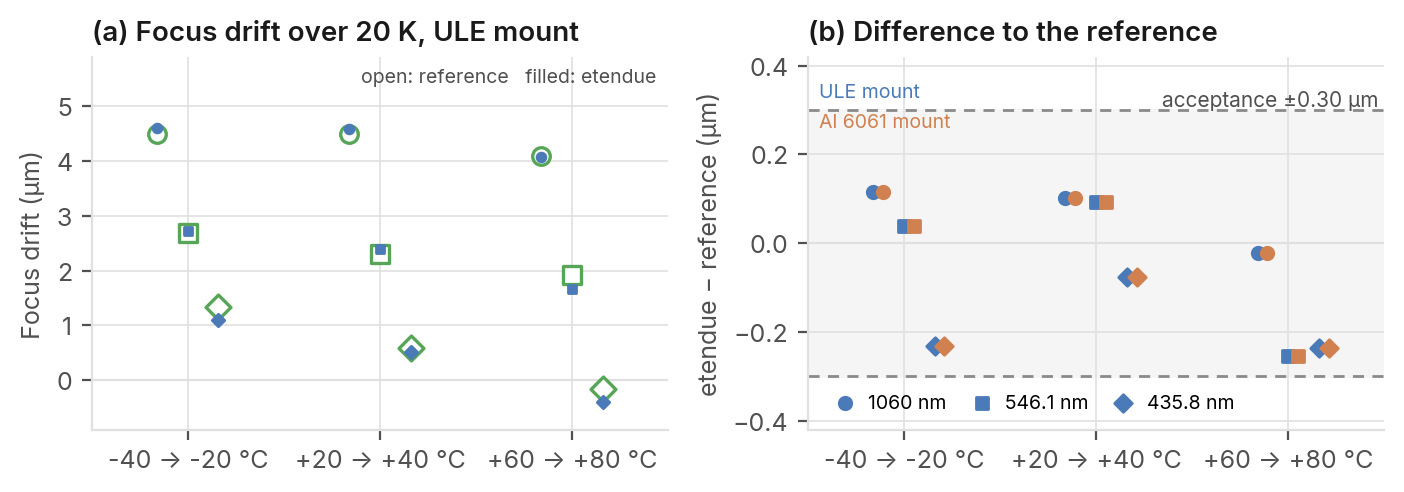
Figure 1. (a) Focus drift at the end of each 20 K interval, measured from the image plane, with the ULE mount: open markers are the reference, filled markers the value computed by etendue. (b) The difference for both mounts. The shaded band is the acceptance written before the measurement.
18/18 9/9 0.0 % 115/116
Focus-drift cases within ±0.30 Absolute dn/dT values of N- Difference of the default All criteria written before the
μm of the reference. The BK7 within ±0.05·10⁻⁶/K of the depth of focus to 2λN², at measurement. The other is
largest difference is 0.255 μm. datasheet. three wavelengths. explained on page 2.
etendue.io Focus drift computed by the athermal analysis of etendue, paraxial method · etendue, November 2026
What was compared, and what differs
Eleven glasses for the index, one lens and two mounts for the focus, 116 values in all.
Table 2. Focus drift at the end of each 20 K interval
(positive: beyond the image plane) Which wavelength stays fixed
The glass maker holds the vacuum wavelength Ref., etendue, Ref., ULE ULE Al etendue, Difference fixed [1, eq. (3)]. etendue, like common lens- Interval Wavelength (μm) (μm) (μm) Al (μm) (μm) design programs, reads a wavelength as measured -40 → -20 °C 1060.0 nm 4.49 4.60 −41.4 −41.3 0.12 in air at the current temperature. The comparison therefore gives etendue the air wavelength of the -40 → -20 °C 546.1 nm 2.69 2.72 −43.2 −43.2 0.04 same light at each temperature; it then reproduces -40 → -20 °C 435.8 nm 1.33 1.09 −44.6 −44.8 −0.23 the published formula to 0.0007·10⁻⁶/K. At a fixed +20 → +40 °C 1060.0 nm 4.49 4.59 −41.4 −41.3 0.10 air wavelength the relative coefficient is higher by +20 → +40 °C 546.1 nm 2.30 2.40 −43.6 −43.5 0.09 0.007 to 0.21·10⁻⁶/K; on the focus drift of Table 2 this accounts for 0.04 to 0.23 μm. Indices are +20 → +40 °C 435.8 nm 0.59 0.51 −45.3 −45.4 −0.08 compared at the spectral lines the sheets name, +60 → +80 °C 1060.0 nm 4.09 4.06 −41.8 −41.8 −0.02 546.074 and 435.8343 nm [5]. +60 → +80 °C 546.1 nm 1.92 1.67 −44.0 −44.2 −0.25
+60 → +80 °C 435.8 nm −0.16 −0.39 −46.1 −46.3 −0.24 What stays outside the criteria
For N-FK51A at 435.8 nm, etendue differs from
| Table 3. Mean dn/dT of N-BK7 over each interval (10⁻⁶/K, | Table 1 by −0.052·10⁻⁶/K; the published formula |
| datasheet rounded to 0.1) | with the constants of the datasheet gives −0.052, |
REL., REL., ABS., ABS., so the tabulated value does not follow from its own
INTERVAL WAVELENGTH SHEET ETENDUE SHEET ETENDUE
formula at the displayed precision. -40/-20 °C 1060.0 nm 2.4 2.35 0.3 0.33
-40/-20 °C 546.1 nm 2.9 2.85 0.8 0.79 Not judged
Table 2 of [1] prints n_d in place of n_e for N-FK58. -40/-20 °C 435.8 nm 3.3 3.30 1.2 1.20 Against the N-FK58 datasheet (n_e = 1.45720), +20/+40 °C 1060.0 nm 2.4 2.36 1.1 1.06 etendue differs by 1.5·10⁻⁶. +20/+40 °C 546.1 nm 3.0 2.95 1.6 1.62
+20/+40 °C 435.8 nm 3.5 3.48 2.1 2.13 Domain of validity
−100 to +140 °C, 365 to 1014 nm; lens and mount +60/+80 °C 1060.0 nm 2.5 2.50 1.5 1.48 at one uniform temperature, in air at 1 atm. +60/+80 °C 546.1 nm 3.1 3.15 2.1 2.11 Gradients and stress birefringence were not +60/+80 °C 435.8 nm 3.7 3.73 2.7 2.68 compared.
Table 4. Every criterion written before the measurement
^(C)^(O)^(M)^(P)^(A)^(R)^(E)^(D)^(Q)^(U)^(A)^(N)^(T)^(I)^(T)^(Y)^(W)^(I)^(T)^(H)^(I)^(N)^(C)^(R)^(I)^(T)^(E)^(R)^(I)^(O)^(N) Conclusions
Lens as loaded (radii, thicknesses, focal length) 1/1 etendue computes the thermal focus drift of a lens N-BK7 constants and index at 20 °C 11/11 in its mount within 0.255 μm of the published law, N-BK7 dn/dT relative to air, 9 values 9/9 at three wavelengths and in three temperature ranges. Fed the same indices, the law and etendue N-BK7 dn/dT absolute, 9 values 9/9 agree to better than 10⁻¹⁰ μm. The one value Relative dn/dT, 11 glasses × 3 wavelengths 32/33 outside the criteria is a table value that its own Expansion coefficient, 11 glasses 11/11 formula does not give.
| Index n_e at 20 °C, 11 glasses (N-FK58 not judged) | 10/10 |
| Thermo-optic constant G, 11 glasses | 11/11 |
| Focus drift, ULE and aluminium mounts | 18/18 |
Default depth of focus, 2λN² 3/3
Total 115/116
References. [1] SCHOTT AG, TIE-19 Temperature Coefficient of the Refractive Index, August 2023, eq. (3)-(10), Tables 1 and 2. [2] SCHOTT AG, data sheet N-BK7, December 2023. [3] T. H. Jamieson, Thermal effects in optical systems, Optical Engineering 20(2), 156-160 (1981). [4] M. J. Riedl, Optical Design Fundamentals for Infrared Systems, SPIE Press, ch. 7, as reproduced in R. Irvin, OPTI 521 report, University of Arizona (2009), Table 1 and p. 2. [5] SCHOTT AG, TIE-29 Refractive Index and Dispersion, August 2023, Table 1.