
imaging
Rebuild a ZEISS 35 mm f/2 lens in etendue.io with Claude via MCP (Part 1)
A full-frame 35 mm f/2 camera lens with 8 elements, two bi-aspheric lenses and an internal focusing group, rebuilt from ZEISS patent US 11,199,681 B2 by an AI model connected to etendue through its MCP server
The design problem
Patent US 11,199,681 B2 (Marco Pretorius, Carl Zeiss AG, 2021) describes a compact 35 mm f/2 lens for full-frame cameras: 8 elements, a front group, a fixed aperture stop, a focusing group that moves inside the lens, and a fixed rear group with two bi-aspheric lenses. Only 57 mm separate the first lens from the sensor. Six tables give the full prescription: 20 surfaces with their radii, thicknesses, glasses and semi-diameters, the air gaps for four focus distances, and the coefficients of the four aspheric surfaces.
Turning such a document into a working model is slow and error-prone when done by hand. Every value has to be typed in, and the patent leaves out part of what a ray trace needs. The question of this case study: can an AI model do this work in etendue, and how close does the result come to the patent?
How the system is built
The AI model used here is Claude, connected to etendue through the etendue MCP server with an API key created in the etendue account. It received the PDF of the patent and a short prompt asking for the embodiment of FIG. 1, exactly as published, without optimisation. It read Tables 1 to 6, built the 22 surfaces of the system in etendue, created one variant per focus position of Table 2 (infinity, 1 m, 0.5 m and 0.3 m), set up an analysis workflow (ray tracing, focal length, MTF against field, field curvature, distortion), ran it on the four variants and saved the project in the etendue account. The engineer reviewed each deduced value along the way.
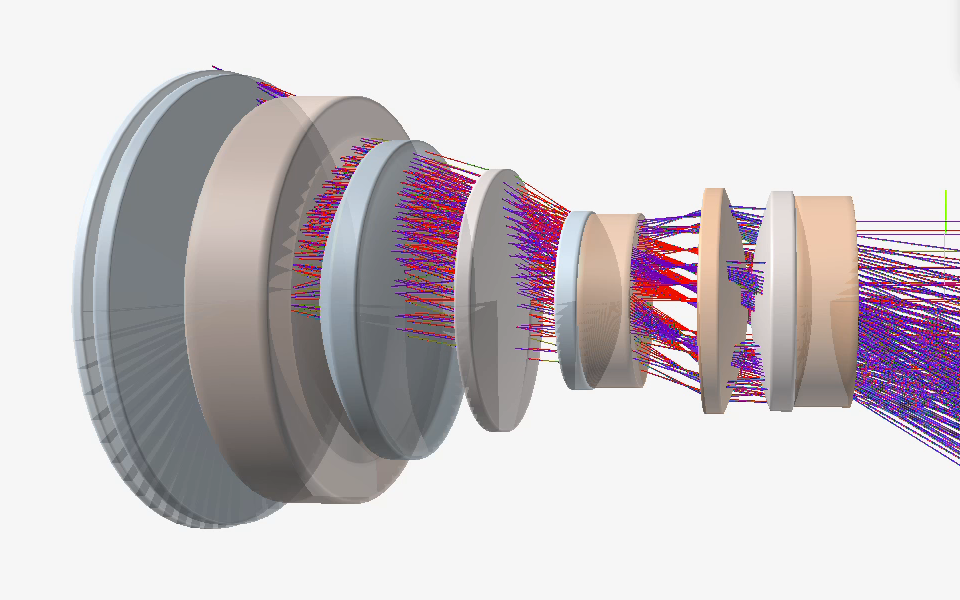
Figure 1. The ZEISS 35 mm f/2 lens rebuilt in etendue, focused at infinity, with the rays of all fields and wavelengths.
Values the patent does not give
The AI model listed every value it had to deduce, with the reason for each:
- Reference wavelength. The patent gives a focal length of exactly 35.00 mm without saying at which wavelength. The d line (587.56 nm) is the only one of the six wavelengths that gives 35.000 mm.
- MTF spectral weights. The patent speaks of a weighted average without giving the weights. Photopic weights reproduce its MTF figure.
- Entrance pupil. 17.5 mm (35 mm at f/2), kept constant over the focus range, since the front group and the stop do not move.
- Semi-diameters. Applied as real apertures, which brings the MTF closer to the patent's figure.
- Field angles at finite distance. The patent gives the fields for an object at infinity only. At 1 m, 0.5 m and 0.3 m, the angles are recomputed to keep the same image heights.
The reading also found four points where the text of the patent does not match its own tables, for example a lens described as biconcave whose radii make it biconvex. The tables were kept as published.
How the rebuilt lens compares with the patent
| Quantity | etendue | Patent |
|---|---|---|
| Focal length at infinity | 35.000 mm | "exactly 35.00 mm" |
| Distortion, d line, peak | 0.30 % | about 0.31 % (FIG. 4) |
| Sagittal MTF on axis, 20 / 40 / 80 lp/mm | 0.93 / 0.83 / 0.67 | about 0.90 / 0.78 / 0.62 (FIG. 3) |
| Sagittal MTF at 10 mm image height | 0.94 / 0.84 / 0.57 | about 0.91 / 0.81 / 0.55 |
| Sagittal MTF at 15 mm image height | 0.94 / 0.84 / 0.59 | about 0.90 / 0.81 / 0.53 |
| Sagittal MTF at 20 mm image height | 0.82 / 0.56 / 0.33 | about 0.80 / 0.58 / 0.33 |
Without any optimisation, the sagittal MTF stays within 0.06 of the patent's figure at every image height and frequency.
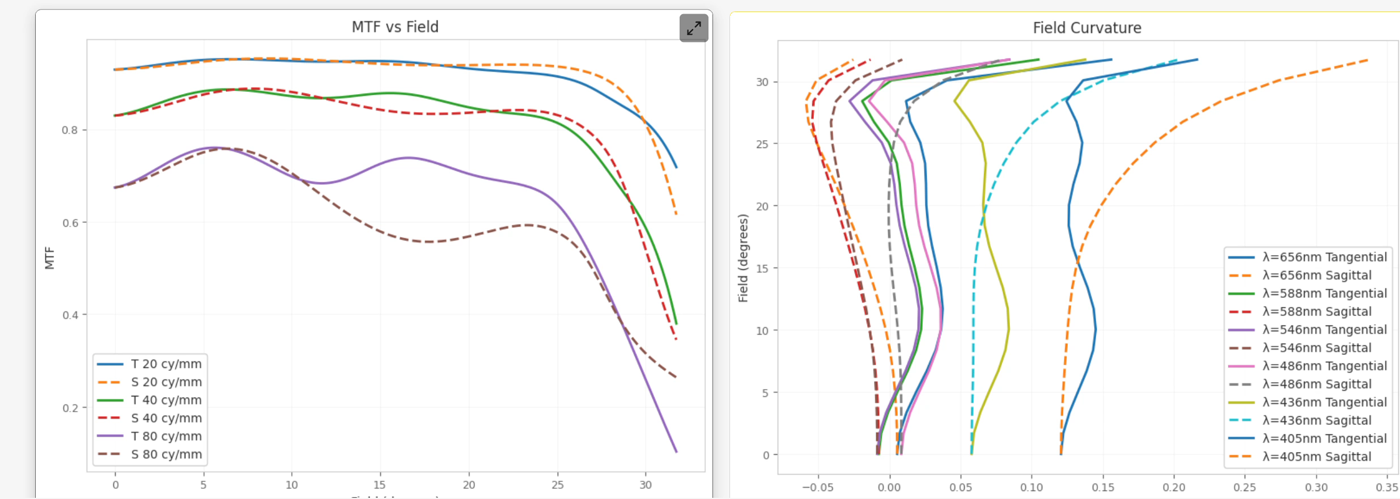
Figure 2. Focus at infinity. Left, MTF against field at 20, 40 and 80 cycles/mm, tangential and sagittal. Right, field curvature for the six wavelengths of the patent.
Four focus positions in one project
Each focus distance of Table 2 is a variant of the same system, and one run gives the analyses of all four side by side.
| Variant | Focal length (d line) | Magnification | Maximum distortion, all wavelengths |
|---|---|---|---|
| Z1, focus at infinity | 35.00 mm | 0 | 0.36 % |
| Z2, focus at 1 m | 33.03 mm | −0.037 | 0.72 % |
| Z3, focus at 0.5 m | 31.09 mm | −0.077 | 1.28 % |
| Z4, focus at 0.3 m (near limit) | 28.53 mm | −0.139 | 2.33 % |
The focal length falls from 35.00 to 28.53 mm as the lens focuses closer, and the distortion grows from 0.36 to 2.33 %.
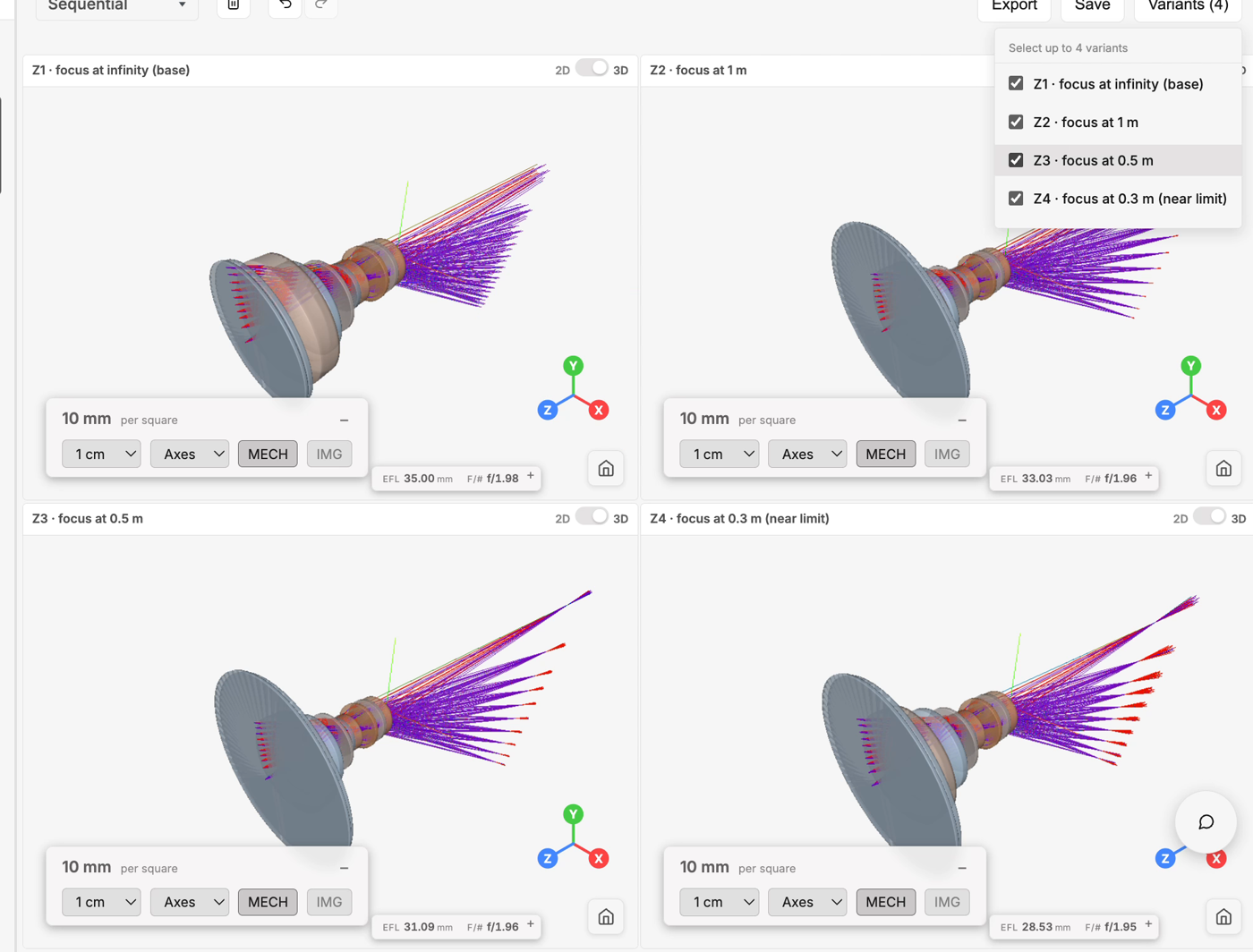
Figure 3. The four focus variants traced in etendue: infinity, 1 m, 0.5 m and 0.3 m.
Reliability of the results
The four variants and five analyses were run twice, once by the AI model through the MCP server and once in the etendue application: the 20 runs succeeded and the MTF, distortion and field curvature agree to 0.001. The total length, the air gaps of the focusing groups and the object-to-sensor distances were checked against the patent at the four focus positions.
What comes next
In part 2 of this case study, the same lens will be rebuilt with ARGOS, the optical design AI model that runs locally with etendue, for teams that cannot share their designs with cloud AI models.
References.
[1] M. Pretorius, Carl Zeiss AG, "Compact camera lens of highest imaging quality for a camera with full-framed sensor", US 11,199,681 B2 (14 December 2021), FIG. 1 to 6 and Tables 1 to 6.